
Multi tier marketing is a structure where revenue, reach or customer attention flows through more than one layer: either people (as in multi-level marketing, where participants recruit and sell through downlines) or channels and audience segments (as in a tiered funnel of awareness, consideration and conversion). For B2B growth teams, the useful meaning is the second one. The first one is mostly a cautionary tale, and we’ll cover it fairly before moving to the version that produces pipeline.
The phrase gets used for both, which is why search results are a muddle of income claims and funnel diagrams. Pick the wrong definition and you’ll either build a recruitment scheme or a tidy diagram nobody measures.
What multi tier marketing means in practice
Multi tier marketing describes any go-to-market model with distinct layers, where each layer has its own audience, job and measure of success. There are two common versions.
- People-based tiers. Multi-level marketing (MLM) and network marketing. Participants earn from their own sales and from the sales of people they recruit. Compensation follows the structure of the network.
- Audience and channel tiers. A layered system where prospects move through stages (for example cold audiences, engaged prospects, sales-ready accounts) and each stage gets different content, channels and sales handling.
- Partner and channel-sales tiers. Resellers, referrers or agencies graded by volume or capability, with different margins, support and co-marketing at each grade.
The commercial test is the same for all three. Does each tier have a defined owner, a defined measure and a clear handoff to the next one? If not, you have a hierarchy, not a system.
How MLM-style multi tier marketing works
In an MLM, a company sells products through independent participants, and those participants earn commission on their own sales plus a share of what their recruits sell. The structure is a tree. Each person sits at a tier, and rewards usually rise with position and team volume.
The standard components are:
- A product or service sold through personal networks, parties or online storefronts.
- Independent participants who buy stock or a starter kit and sell on the company’s behalf.
- A compensation plan that pays on personal sales, team sales and rank advancement.
- Recruitment, because the plan rewards building a downline.
Legitimate MLMs and illegal pyramid schemes are separated by one question: where does the money come from? If income depends mainly on genuine retail sales to customers outside the network, it’s a lawful business model, whatever you think of it. If income depends mainly on recruitment fees and participants buying inventory themselves, it’s a pyramid scheme.
What the earnings data says
The evidence on participant income is sobering. An FTC staff review of 70 MLM income disclosure statements found that most participants made $1,000 or less per year, less than $84 a month, and that figure may not account for expenses. In at least 17 of the MLMs reviewed, most participants made no money.
That goes some way to answering why people quit MLMs. Income is concentrated at the top, costs fall on the bottom, and the sales effort tends to rely on personal networks that get exhausted. None of this means every participant fails, only that the average outcome is poor.
Why people quit MLM
People quit MLM mainly because the income doesn’t cover the costs of staying in. Stock purchases, event fees, software and travel come out first, and the earnings that remain are small for most participants, as the FTC disclosure data above suggests.
Other common reasons:
- Sales stall once personal networks are exhausted.
- Recruitment pressure strains relationships.
- Time commitment exceeds the return.
- Rank requirements keep rising, so the effort required to stay level goes up.
For a B2B marketing leader, the lesson isn’t about MLM at all. It’s about structure. A model where the cost sits at the bottom and the reward at the top loses its base. Your funnel behaves the same way if the early tiers are starved or unmeasured.
Multi tier marketing vs a pyramid scheme
A pyramid scheme pays people mainly for recruiting, not for selling to real customers. A legitimate multi-level business pays mainly on retail sales to consumers who aren’t participants. The line is about the source of the money, not the shape of the org chart.
| Feature | Multi-level marketing | Pyramid scheme |
|---|---|---|
| Main source of income | Product sales to outside customers | Recruitment fees and participant purchases |
| Product value | Real product with a market | Product is often incidental |
| Legal status | Lawful if compliant | Illegal in many countries |
| Participant buy-in | Often a starter kit | Often large upfront payments |
If you’re assessing a partner program, referral scheme or reseller network for your own business, apply the same test. Pay for revenue that comes from real customers, not for activity that only feeds the structure.
Multi tier marketing as a layered B2B system
For a B2B company, the practical form of multi tier marketing is a layered funnel in which each stage has a different audience, message, channel and measure. Layers only work when data moves between them. Without that, you’ve built three separate campaigns and called it a funnel.
A workable three-tier model looks like this:
- Tier one: demand capture and discovery. Search (paid and organic), answer engine visibility and content that matches problem-aware searches. Measure qualified visits and enquiry quality, not impressions.
- Tier two: nurture and evaluation. Email, retargeting, case-led content and sales-enablement material for prospects who’ve shown intent. Measure engagement tied to account progression.
- Tier three: conversion and expansion. Sales follow-up, proposals, onboarding and customer marketing. Measure pipeline value, win rate, cycle length and retention.
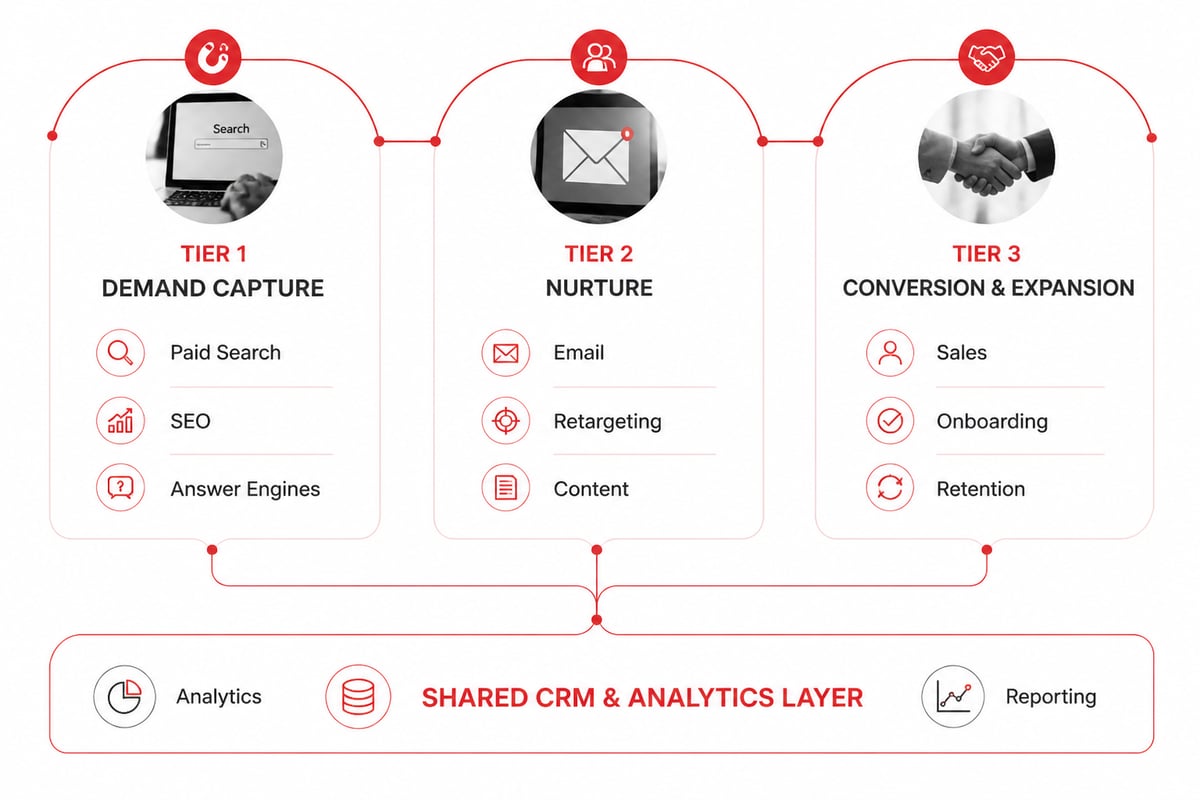
The shared data layer is the point. Tier one should know which enquiries became revenue. Tier three should know which sources brought the good customers. When those answers live in different tools owned by different people, budget gets spent on whatever reports best, not what pays best.
Why silos break layered marketing
Layered marketing fails when each tier reports on its own metrics and nobody reconciles them to revenue. The classic pattern: paid search reports cheap leads, sales reports poor-quality leads, and both are telling the truth.
Typical silo symptoms:
- Marketing counts form fills while sales counts opportunities, and the two numbers never meet.
- CRM stages are defined differently by different people.
- Attribution is last-click in one report and first-touch in another.
- Automation sequences fire without knowing the account is already in a sales conversation.
Fixing this is a systems problem before it’s a technology problem. Buying another platform on top of a broken definition of “qualified” just produces faster confusion. This is where an audit earns its keep: map the tiers, the handoffs, the definitions and the data flows as they actually exist, then decide what to change. If you want to see how integrated planning ties these together, the marketing and growth work is built around exactly that sequence.

Which tier should get your budget?
Put budget where evidence shows the biggest constraint, not where the channel report looks best. If good prospects aren’t arriving, fund tier one. If they arrive and stall, fund tier two or sales alignment. If they close but churn, fund tier three.
A quick diagnostic, in order:
- Are enough of the right prospects finding you? Check search query intent and enquiry quality.
- Do they progress? Check stage-to-stage conversion in your CRM.
- Do they close and stay? Check win rate, sales cycle and retention by source.
Most teams skip straight to buying more traffic. That’s the cheapest-looking fix and often the wrong one. Search is a good example of a tier-one channel that rewards connected measurement: ranking or click volume means little unless you can trace it to qualified enquiries and revenue. Data-Led SEM, AEO and PPC takes that approach, connecting paid search, SEO and answer engine optimisation to qualified enquiries and sales, then using continuous measurement to show where the next dollar should go. For the organic side, the strategic opportunist’s guide to SEO in 2026 covers how search is shifting.
What is the 3-3-3 rule for marketing?
The 3-3-3 rule is a loose planning heuristic with no single agreed definition, and versions vary between practitioners. A common reading is three goals, three channels and three messages for a planning period, which forces focus. Nobody has run a controlled trial of it.
Used that way, it fits tiered marketing well. Three goals might map to the three tiers. Three channels per tier stops spread-thin execution. Three core messages keep the sequence coherent as prospects move from one layer to the next. Treat it as a discipline for saying no, not a proven formula. Nobody has run a controlled trial of it.
Partner and channel tiers
Tiered partner programs grade resellers, referrers or agencies by performance, with benefits that rise as they bring more qualified revenue. They work when tiers reward outcomes and fail when they reward volume of sign-ups.
If you run one, keep the structure honest:
- Define tier criteria by closed revenue or customer retention, not by headcount recruited.
- Give each tier the specific support it needs: lead routing, co-marketing assets, training.
- Track partner-sourced pipeline in the same CRM as everything else, with consistent stage definitions.
- Review quarterly and move partners up or down on evidence.
The MLM comparison is useful as a warning. Reward the wrong behaviour and you get that behaviour in volume. Rewarding recruitment gives you recruits. Rewarding revenue from real customers gives you revenue.
How to build a multi tier marketing system
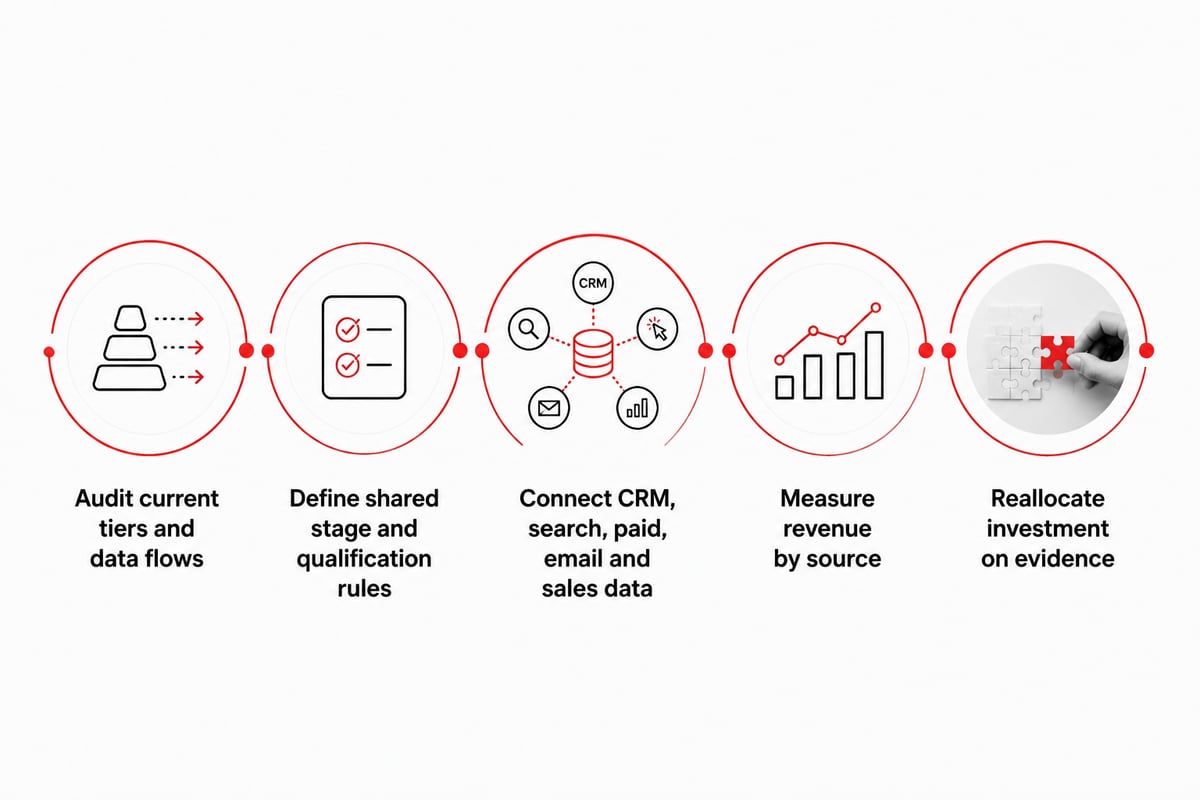
Build it in this order: audit, define, connect, measure, then optimise. Tools come late, because a platform can’t fix a definition problem.
- Audit what exists. List every channel, tool, automation and report. Note who owns each and where data stops moving. Don’t change anything yet.
- Define the tiers and handoffs. Agree what makes a prospect qualified, what triggers a move to the next tier and who acts when it happens. Write it down in plain English.
- Connect the data. Link CRM, advertising, analytics, email and sales activity so a single record shows a prospect’s path. Technology is a tool here, not a trophy. If a simpler setup answers the commercial questions, use it.
- Measure to revenue and profit. Report pipeline, win rate, cycle length and retention by source and tier. Drop vanity metrics from leadership reporting.
- Reallocate on evidence. Move spend and effort toward the tier and channel with the clearest constraint.
Automation and AI fit inside this sequence as accelerators. Lead scoring, routing, content assistance and anomaly detection all help once definitions and data are sound. On broken foundations they make the mess run faster. For ongoing guidance on connected channels, the marketing channel work and the data marketing page show how measurement sits underneath all of it.
If you’re comparing how search tooling fits into a tiered plan, Best SEO Tools is one resource for looking at AI-era ranking approaches.
Is multi tier marketing right for your business?
It’s right when you can name the tiers, the owner of each and the number that proves each one is working. It’s wrong when it’s a label for a diagram or, in the MLM sense, when income depends on recruiting rather than selling to real customers.
Quick checks before committing:
- Can you trace a closed deal back through every tier it passed through?
- Do sales and marketing share one definition of a qualified prospect?
- Would your reporting survive a finance director asking where the revenue came from?
- If you run a partner or referral program, are you paying for customer revenue or for sign-ups?
If most answers are no, the next move is an audit, not another tool or another tier.
FAQ
Is multi tier marketing the same as multi-level marketing?
Not quite. Multi-level marketing is one specific people-based version, where participants earn from their own sales and their recruits’ sales. Multi tier marketing is the wider idea of layered structures, including funnel stages, channel layers and partner tiers.
Which multi-level marketing company is the best?
There’s no sensible way to name one, and the FTC’s review of income disclosures suggests the question matters less than the model. Across the 70 income disclosure statements it reviewed, most participants made $1,000 or less a year, so check a company’s published income disclosure before anything else.
What is the 70 rule for MLM?
There’s no single official 70 rule, and the phrase is used loosely. It’s often a reference to retail-sales tests, where a stated share of product volume is meant to go to genuine customers rather than participants. Check the current regulator guidance for your country before relying on any rule of thumb.
Your next step is to map the tiers you already run, from first search to closed deal, and mark every point where data stops moving or a definition changes hands. That map is the audit’s first draft, and it usually shows where pipeline leaks before any new spend does. If you’d like that done properly across CRM, search, paid, email and sales, Data-Led SEM, AEO and PPC is a good place to start on the search side, and touchpoint.systems can connect the whole system behind it.