
Most media campaigns fail before they launch. Not because the creative is weak or the targeting is wrong, but because there’s no proper system connecting the activity to the business outcome. Money flows into platforms, impressions get recorded, clicks happen, and somewhere between the spreadsheet and the dashboard, the link to actual revenue disappears. This isn’t a media problem. It’s a systems problem.
Why Most Media Campaigns Don’t Work
The industry talks about media campaigns as though they’re discrete projects with start dates, end dates and tidy results. In reality, they’re fragments of a broader customer journey that starts before the first impression and continues long after the last click.
Most businesses run media campaigns without answering three fundamental questions: what exactly are we trying to achieve, how will we know it worked, and what happens after someone responds? Without clear answers, you’re left with vanity metrics that don’t connect to revenue, attribution models that contradict each other, and a pile of platform dashboards that can’t talk to one another.
The Real Cost of Disconnected Activity
When media campaigns run in isolation from the rest of your marketing and sales operations, several predictable problems emerge:
- Wasted budget on audiences who were never going to buy or were already planning to purchase
- Invisible leakage between impression, click, enquiry, opportunity and customer
- Contradictory data across platforms that can’t be reconciled
- No understanding of what actually drove revenue versus what took credit for it
- Repeated mistakes because there’s no closed loop between spend and outcome
The Nielsen cross-media measurement research shows that most campaigns operate with incomplete visibility across channels, making it nearly impossible to allocate budget effectively or understand what combination of touchpoints creates value.

Planning Media Campaigns That Connect to Revenue
Effective media campaigns start with the outcome and work backward. That means defining what success looks like in commercial terms, identifying where prospects currently drop out, and building the infrastructure to track what happens between first exposure and final purchase.
Define the Commercial Outcome First
Before selecting channels or audiences, be explicit about what the campaign must deliver. Not “awareness” or “engagement”. Actual business results: qualified enquiries, booked appointments, signed contracts, revenue within a defined period.
This forces clarity about who you’re targeting, what offer will move them, what friction currently stops them, and what needs to happen after they respond. It also determines how much you can afford to spend and what measurement infrastructure must exist before the first dollar goes out the door.
| Question | Why It Matters | Where Systems Fail |
|---|---|---|
| What action do we want? | Defines success and determines creative, offer and landing experience | Campaigns optimise for clicks instead of qualified action |
| Who should take it? | Shapes targeting, channel selection and messaging | Broad targeting wastes budget on unqualified audiences |
| What happens next? | Ensures handover to sales or nurture doesn’t break | Leads disappear between form and CRM |
| How will we measure it? | Creates accountability and enables optimisation | Attribution breaks; platforms contradict each other |
Build Measurement Before Launch
Most campaigns launch first and retrofit measurement later. By then, it’s too late to capture the data needed to understand what worked. Measurement infrastructure should be in place and tested before spend starts.
That means tracking pixels installed and firing correctly, form submissions flowing into CRM with source attribution, phone enquiries logged with campaign context, and revenue closed-loop back to the original campaign and channel. Without this, you’re flying blind.
The Deloitte analytics research confirms that advanced measurement capabilities directly correlate with better budget allocation and higher campaign ROI. Businesses that connect media activity to revenue outcomes make better decisions faster.
Selecting and Orchestrating Media Channels
Channel selection shouldn’t be based on what’s trendy or where the rep gave you a discount. It should be determined by where your prospects pay attention, what format suits your message, and what combination of touchpoints creates the conditions for action.
Match Channel to Intent and Journey Stage
Different channels serve different roles. Search captures existing intent. Display and social generate awareness and consideration. Retargeting reminds and reinforces. Email nurtures. Each has strengths and limitations, and most campaigns require several channels working together.
The mistake is treating each channel as independent. A prospect might see a display ad, search your brand, visit the site, leave, see a retargeting ad, return via email, and finally convert after a follow-up call. Every platform wants credit. Only a connected system knows what actually contributed.
- Map the current journey – where do prospects come from, what do they do, where do they drop out?
- Identify gaps and friction – where is attention lost, where does handover break, what questions aren’t answered?
- Select channels that address those gaps – match format and placement to the role it needs to play
- Connect data flows – ensure attribution, audience syncing and measurement work across platforms
- Test combinations, not just individual channels – measure the system, not isolated pieces
Orchestrate Timing and Frequency Across Touchpoints
Frequency matters, but most businesses measure it per channel instead of per person. Someone might see your ad twice on Facebook, three times on Google, once on LinkedIn, and receive two emails in the same week. Individually, none of those seem excessive. Together, it’s annoying.
Coordinating frequency and timing across channels requires a view of the prospect that transcends platform silos. That means unified audience lists, shared suppression rules, and orchestration based on behaviour rather than arbitrary schedules. When measurement becomes cookieless, this coordination becomes harder but more important.

Creative and Messaging That Moves the Middle
Creative isn’t decoration. It’s the mechanism that connects attention to action. Most media campaigns treat creative as an afterthought, slapped together after the strategy is “done”. That’s backwards.
Match Message to Stage, Channel and Audience
The same message doesn’t work everywhere. Someone searching for your product needs different information than someone seeing your brand for the first time. A retargeting ad should acknowledge prior engagement, not repeat the same generic pitch.
Effective creative considers:
- What the prospect already knows and what question they’re trying to answer right now
- Where they are in the journey and what needs to happen next
- What format and length the channel allows and the context permits
- What action is realistic at this stage and what offer will motivate it
Copy should be specific, benefit-focused and built around what the prospect cares about-not what you want to tell them. Avoid jargon, hype and claims you can’t substantiate. Test variations that address different objections, motivations and levels of sophistication.
Align Landing Experience With Campaign Promise
The biggest waste in most media campaigns happens after the click. Someone responds to an ad, lands on a page that doesn’t match the promise, can’t find what they need, and leaves. Budget spent acquiring attention, value destroyed by a disconnected experience.
Your landing page, form, chat, phone script or next step must continue the conversation the campaign started. Same language, same offer, same visual treatment. If the ad promised a specific guide, the page should deliver it immediately-not bury it three clicks deep behind a generic homepage.
Conversion rate optimisation focuses on this handover, reducing friction and ensuring qualified prospects don’t leak out because the post-click experience breaks the promise or creates unnecessary obstacles.
Measurement, Attribution and Optimisation
Running media campaigns without proper measurement is expensive guesswork. But measurement alone doesn’t improve outcomes. You need attribution that connects activity to revenue, analysis that identifies what’s working, and the discipline to act on what the data shows.
Build Attribution That Reflects Reality
Every platform wants to claim credit for every conversion. Facebook says it drove the sale. Google says it drove the sale. LinkedIn says it drove the sale. They’re all partly right and entirely wrong, because most conversions involve multiple touchpoints over days or weeks.
Single-touch attribution (first click or last click) is simple but misleading. Multi-touch models are more realistic but harder to implement and still rely on assumptions. The goal isn’t perfect attribution-it’s good-enough visibility into what combination of activity generates revenue.
| Attribution Model | Strengths | Weaknesses | When to Use |
|---|---|---|---|
| Last click | Simple, easy to track | Ignores everything before final action | Short sales cycles, single-channel campaigns |
| First click | Credits awareness | Ignores nurture and closing activity | Top-of-funnel focus, long consideration |
| Linear | Acknowledges all touchpoints | Treats every interaction equally | When you need a baseline multi-touch view |
| Time decay | Weights recent activity higher | Still arbitrary | Complex journeys with defined stages |
| Custom/data-driven | Reflects actual patterns | Requires data science and volume | Sufficient data, mature measurement |
The Kantar measurement framework provides practical guidance on building attribution models that balance simplicity with commercial relevance, focusing on what improves decisions rather than academic precision.
Connect Campaign Data to Business Outcomes
Attribution tells you which touchpoints contributed. Revenue analysis tells you whether the campaign made money. Both are necessary; neither is sufficient.
Connect media campaigns to actual business results by tracking:
- Cost per qualified enquiry – not just clicks or form fills, but prospects worth pursuing
- Conversion rate by source – which channels and campaigns deliver prospects that close
- Customer acquisition cost (CAC) – total cost to acquire a paying customer, not just a lead
- Revenue per campaign – what customers brought in by each campaign actually spent
- Payback period and lifetime value – how long to recover investment and long-term value created
This requires connecting media platforms, CRM, sales pipeline and financial data into a unified view. Most businesses don’t have this, which is why they can’t answer basic questions about what’s working. An audit before prescription identifies where these connections are broken and what needs fixing before more money flows into campaigns.
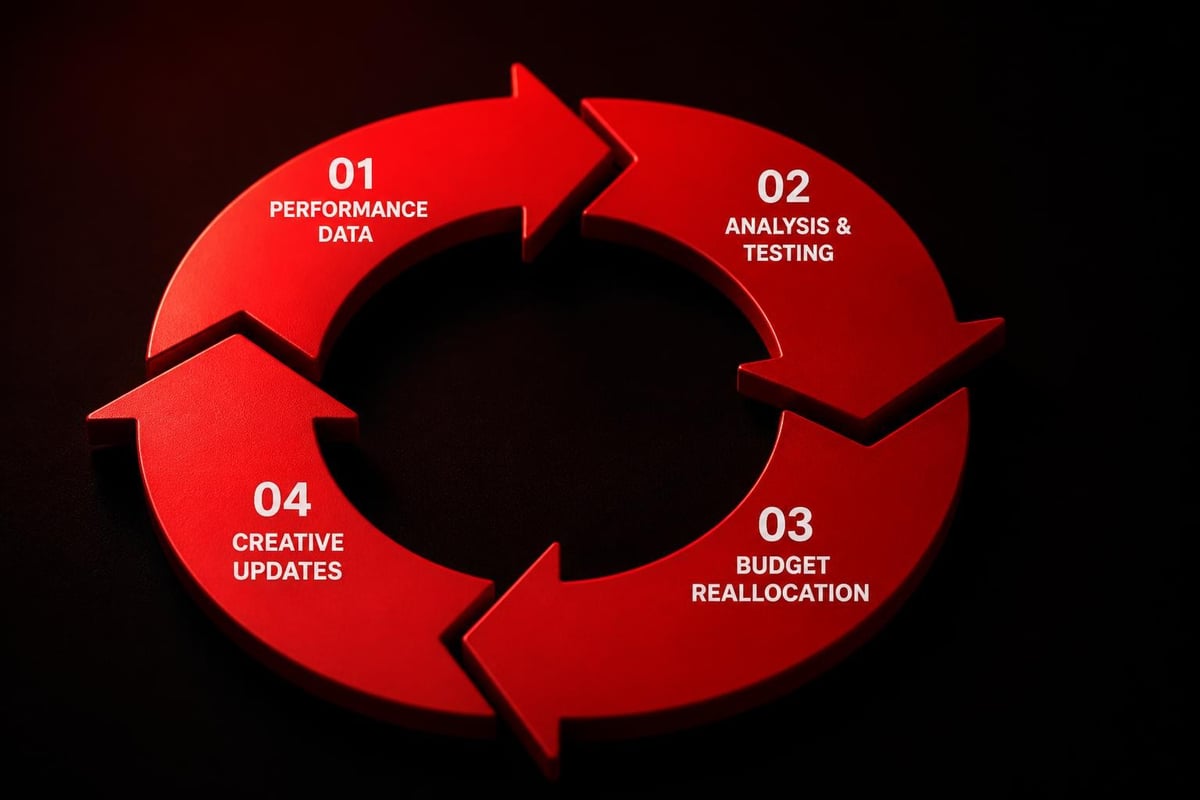
Optimise Continuously, Not Just at Campaign End
Media campaigns aren’t set-and-forget. Budget shifts, audience behaviour changes, competition responds, and creative wears out. Effective optimisation happens continuously, based on real performance data, not quarterly reviews.
That means:
- Daily monitoring of key metrics – spend, delivery, cost per result, conversion rates
- Weekly analysis of trends – what’s improving, what’s declining, what’s changed
- Bi-weekly creative refresh – test new angles, update worn-out assets, respond to performance
- Monthly budget reallocation – move money toward what’s working, cut what isn’t
- Quarterly strategic review – assess overall effectiveness, update targeting and offers
The goal is a learning system that gets better over time, not a campaign that runs to completion and starts from scratch next quarter.
Common Mistakes That Waste Campaign Budget
Even well-planned media campaigns fail when execution breaks down or fundamental mistakes creep in. Most are avoidable with proper systems and discipline.
Optimising for Platform Metrics Instead of Business Outcomes
Platforms incentivise you to optimise for their preferred metrics: lower cost per click, higher engagement rate, more impressions. These matter only if they connect to revenue. A cheap click from an unqualified audience is worthless. High engagement that doesn’t move prospects closer to purchase is entertainment, not marketing.
Define success in business terms first, then work backward to platform metrics. If the platform can’t deliver the outcome you need, it’s the wrong platform-regardless of how impressive the vanity metrics look.
Running Campaigns Without Connected Systems
Media campaigns generate activity. Systems convert activity into revenue. Without CRM integration, marketing automation, proper handover to sales, and closed-loop reporting, campaigns become expensive noise that disappears into the void.
The Pew Research data on media consumption shows that attention is fragmented across platforms and formats, making integration even more critical. Prospects move between channels; your systems must track them accurately across those movements.
Treating Each Campaign as Independent
Most businesses run campaigns as isolated projects: this month’s promotion, that quarter’s product launch, this event, that seasonal push. Each gets planned, executed and measured separately, with no cumulative learning or shared infrastructure.
Better to build a connected system where campaigns share audiences, creative libraries, measurement frameworks and optimisation insights. Each campaign becomes a test that improves the next one, rather than starting from zero every time.
Ignoring the Handover to Sales
Marketing’s job doesn’t end at lead generation. It ends when the prospect becomes a customer or is definitively disqualified. Most media campaigns stop tracking at form submission, ignoring what happens during sales follow-up.
If leads aren’t followed up quickly, if the sales conversation doesn’t match the campaign promise, if objections aren’t anticipated and handled-the campaign failed regardless of how many leads it generated. Connect marketing and sales workflows so the handover works and both sides know what happened.
Building Campaigns Into Growth Systems
Individual media campaigns deliver temporary results. Connected systems deliver compounding growth. The difference is whether each campaign contributes to a shared foundation that improves over time or operates as a one-off event that starts and stops.
Shift From Campaign Thinking to System Thinking
Campaign thinking optimises individual initiatives. System thinking optimises the platform those initiatives run on-shared audiences, reusable creative, connected data, refined processes, cumulative learning.
This means:
- Unified customer data across all campaigns and channels, not separate lists per platform
- Reusable creative frameworks that can be adapted quickly, not bespoke assets every time
- Standardised measurement that enables comparison and learning across campaigns
- Connected technology that reduces manual work and ensures data flows reliably
- Documented processes so campaigns can be executed consistently and improved systematically
A system turns media campaigns from expensive experiments into reliable growth engines.
Use Campaigns to Test and Refine the System
Every campaign is an opportunity to learn something useful about your audience, messaging, offers, channels or conversion process. Most businesses waste this by not capturing insights or applying them to future activity.
Build a feedback loop where campaign results update your understanding of what works, refine your targeting and creative, improve your processes, and inform budget allocation. Over time, your system gets smarter and more efficient-not just louder.
Connect Media to the Full Customer Journey
Media campaigns generate attention and initial response. Revenue comes from what happens next: nurture sequences, sales conversations, onboarding, delivery, upsells, referrals. None of that happens automatically.
Connect your media campaigns to the complete growth system-from first impression through customer retention-so every touchpoint reinforces the others and nothing valuable leaks out between stages.
Media campaigns work when they’re built into systems that connect activity to outcomes, measurement to decisions, and channels to each other. Without that foundation, you’re spending money on disconnected noise that might generate metrics but won’t reliably generate revenue. If your campaigns aren’t delivering the growth you need, the problem is usually structural-not creative. touchpoint.systems audits, designs, builds and manages integrated growth systems that replace siloed campaigns with connected infrastructure, ensuring your marketing investment flows through to measurable revenue and profit.