
Most businesses treat their point of sale as a transaction processor. Money goes in, receipt comes out, maybe some basic inventory tracking happens in the background. What gets ignored is that every marketing point of sale event captures intent, preference, frequency and value data that should feed directly into how you acquire and retain customers. When that data sits trapped in a POS system while your marketing operates from incomplete CRM records and campaign platforms that don’t know what actually sold, you’re running campaigns blind to the outcomes that matter.
What Marketing Point of Sale Actually Means
Marketing point of sale is the practice of connecting transaction data, customer behaviour and purchase patterns from POS systems into your broader marketing infrastructure. It’s not about slapping promotional displays near checkouts or running in-store advertising, though those might be components. It’s about building systems where purchase data informs targeting, messaging, timing and measurement across every channel.
The value sits in closed-loop visibility. When your CRM knows what customers bought, when they bought it, what they paid, and how that purchase relates to previous touchpoints, you can measure which marketing activities drive revenue instead of just clicks or impressions. You can segment based on actual behaviour rather than demographic guesses. You can trigger follow-up based on purchase frequency, basket composition or lifetime value instead of arbitrary time delays.
Most established businesses have the data. It’s just not connected to anything useful. POS systems export to accounting software. Marketing platforms run campaigns using email lists or audience segments built from web behaviour. The gap between transaction reality and marketing activity costs you margin, retention and the ability to prove what’s working.

Purchase Data That Marketing Should Use
Not every data field from your POS matters for marketing purposes. Some are compliance requirements, some are operational noise. What you need are the signals that indicate intent, value and behaviour patterns that improve targeting or measurement.
Transaction-level data worth connecting:
- Customer identifier (email, phone, loyalty number)
- Purchase date and time
- Product or service category
- Item-level details (SKU, variant, quantity)
- Transaction value (gross, net, margin where available)
- Payment method
- Location or channel (store, online, mobile)
- Staff member or referral source
- Discount or promotion codes applied
Derived signals that matter more:
- Purchase frequency and recency
- Average order value and trends
- Product category preferences
- Lifetime value to date
- Margin contribution per customer
- Basket composition patterns
- Channel and time-of-day preferences
The raw transaction data is a record. The derived signals are what make marketing point of sale useful. When your CRM can segment customers by recency, frequency and value automatically, you stop sending the same generic email to dormant customers and high-value repeat buyers. When your advertising platforms can build lookalike audiences from actual purchasers instead of newsletter subscribers, acquisition efficiency improves.
| Data Type | Marketing Use Case | System Requirement |
|---|---|---|
| Customer ID + email | Trigger post-purchase sequences | POS → CRM sync |
| Purchase frequency | Segment active vs dormant | CRM calculated field |
| Product category | Personalise offers and content | POS → marketing platform |
| Transaction margin | Prioritise high-value retention | POS → analytics + CRM |
| Location/channel | Optimise media spend by geography | POS → ad platforms |
Getting this data out of your POS and into systems that use it requires API connections, regular syncs, field mapping and error handling. It’s not difficult technically but it rarely happens because POS vendors, CRM platforms and marketing tools are sold and implemented by different people who don’t think about the whole system.
Retail Media and In-Store Activation
The phrase “marketing point of sale” often gets conflated with in-store advertising or retail media. That’s one application, but a narrow one. Retail media has grown significantly as retailers monetise their customer data and physical locations by selling ad inventory to brands. According to Skai’s 2025 State of Retail Media report, retail media networks are expanding beyond digital properties into in-store formats, creating new measurement challenges and integration requirements.
For retailers, this means treating physical locations as media channels. Digital screens near checkouts, shelf displays with QR codes, receipt-based offers and app-triggered promotions all become inventory. The marketing point of sale becomes a media activation point, not just a transaction logger.
For brands selling through retail channels, it means budget is shifting toward retailer-controlled environments where measurement depends on access to POS data. You’re buying media based on promised reach, but proving attribution requires linking ad exposure to purchase data that the retailer controls. As Nielsen points out in their retail media attribution analysis, independent measurement becomes critical when the same party sells the media, controls the data and reports the results.
In-Store Formats and Measurement Gaps
The IAB’s report on in-store retail media identifies several formats gaining traction:
- Digital screens and video walls
- Smart carts with integrated displays
- Shelf-edge displays and electronic labels
- Audio advertising in-store
- Receipt and bag advertising
- Mobile app notifications triggered by location
Each format creates a different measurement problem. Digital screens can count impressions but not attention or influence. Smart carts can track journey and dwell time but not whether the customer was already planning to buy. Receipt offers are measurable if redemption codes are tracked, but most aren’t connected to CRM systems that would close the loop.
The promise is precision: show the right message to the right person at the exact moment they’re deciding. The reality is fragmented measurement, inconsistent data standards and activation systems that don’t talk to each other. Most businesses experimenting with in-store retail media are measuring media delivery, not commercial outcomes.
Building Connected POS Marketing Systems
Making marketing point of sale work requires treating POS data as a first-class input to your marketing infrastructure, not an afterthought. That means technical integration, yes, but also process design and governance so the data stays accurate, timely and usable.
System Architecture Requirements
Core integration points:
- POS to CRM sync: Customer records, transaction history, product preferences, lifetime value
- POS to marketing automation: Purchase triggers, segment updates, personalisation data
- POS to analytics platform: Revenue attribution, campaign ROI, customer journey tracking
- POS to advertising platforms: Audience building, conversion tracking, lookalike modelling
- CRM to POS (reverse flow): Customer preferences, communication opt-ins, marketing attribution codes
Most businesses have one or two of these connections. Few have all five working reliably. When you do, the marketing point of sale becomes a control point: every transaction updates customer records, recalculates segments, triggers workflows and feeds measurement systems automatically.
The technical pattern is usually middleware or iPaaS (integration platform as a service) sitting between POS and marketing systems. Direct API connections work for simple scenarios but break when you add more platforms or need transformation logic. When evaluating stack interoperability requirements, the POS integration is typically the messiest because POS vendors are slower to modernise APIs and data models than cloud marketing platforms.
Data Quality and Timing
POS data is only useful if it’s accurate, complete and timely. Common problems include:
- Missing or inconsistent customer identifiers (no email captured at checkout)
- Duplicate customer records across systems
- Product categorisation mismatches between POS and marketing platforms
- Delayed sync (daily batches instead of near-real-time)
- Incomplete transaction data (missing discount codes, referral sources)
Fixing these requires operational discipline:
- Staff training on customer data capture
- Validation rules at point of entry
- Regular audits of match rates and data completeness
- Automated alerts when sync fails or data quality degrades
- Clear ownership of data standards across systems
Real-time or near-real-time sync matters more than most businesses assume. If a customer purchases on Monday but your CRM doesn’t update until Tuesday night, your automated “welcome new customer” email might arrive after they’ve already received their product and moved on. Worse, they might receive an ad campaign still treating them as a prospect. Timing gaps create customer experience problems that erode trust and reduce the effectiveness of your next message.

Campaign Strategies Using POS Data
Once purchase data flows reliably into your marketing systems, the strategic opportunities expand beyond generic campaigns and demographic targeting.
Purchase-Triggered Workflows
The simplest application is transactional: confirm the purchase, send receipt, provide tracking. The more valuable application is behavioural: use what was purchased to inform what happens next.
Examples that work:
- First-purchase onboarding: Different messaging for first-time buyers vs repeat customers, tailored by product category purchased
- Replenishment reminders: Trigger based on average reorder cycle for consumables, adjusted by individual customer patterns
- Cross-sell sequences: Recommend complementary products based on what they bought, not generic bestsellers
- Loyalty milestones: Recognise spending thresholds, purchase frequency or anniversaries with relevant offers
- Win-back campaigns: Target customers by recency and previous value, with messaging specific to their lapsed category
Each workflow requires POS data to feed the trigger conditions, segment definitions and personalisation tokens. When your email platform or marketing automation tool can read transaction history directly, you stop relying on manual uploads and spreadsheet merges.
Attribution and Revenue Measurement
Marketing point of sale data is the most reliable source for measuring campaign effectiveness. Clicks, impressions, form fills and even leads are proxies. Revenue, margin and customer lifetime value are outcomes.
Closed-loop attribution connects marketing touchpoints to actual purchases. When your analytics platform can trace a customer journey from first ad click through multiple touchpoints to POS transaction, you can calculate cost per acquisition, payback period and incrementality with real numbers instead of modelled estimates.
Deloitte’s omnichannel retail marketing playbook emphasises using POS and loyalty data to measure true omnichannel behaviour and optimise spend allocation across channels. The approach requires connecting online and offline touchpoints into a single customer view, which most businesses claim to have but few actually implement properly.
What connected attribution enables:
- Compare channel performance by revenue and margin, not just lead volume
- Identify which campaigns drive high-value vs low-value customers
- Optimise bid strategies based on predicted lifetime value
- Prove marketing contribution to finance and leadership with transaction-level evidence
- Reallocate budget toward channels that drive profitable growth
The alternative is optimising for activity metrics that look good in dashboards but don’t correlate with commercial outcomes. Cost per click might drop while cost per profitable customer increases. Conversion rates might improve while average order value and margin decline.
Technical Considerations and Platform Requirements
Building a functional marketing point of sale system means choosing platforms and integration approaches that support reliable data flow, not just feature checklists.
POS Platform Capabilities
Modern POS systems vary widely in their ability to support marketing use cases. Some are transaction processors with minimal data export. Others include built-in loyalty, customer profiles and API access that makes integration straightforward.
Capabilities that matter:
- REST APIs for real-time transaction and customer data
- Webhook support for event-driven triggers
- Flexible customer data fields and identifiers
- Product categorisation and custom attributes
- Multi-location and channel support
- Export formats that include all transaction detail
According to Oracle and IHL’s POS market study, newer POS and mobile POS systems increasingly include personalisation engines, edge AI capabilities and unified commerce features designed to support omnichannel marketing. The gap between legacy systems and modern platforms is widening, which creates technical debt for businesses that delay upgrades.
If your current POS can’t provide clean customer identifiers or timely transaction exports, your marketing point of sale capability will be limited regardless of how sophisticated your CRM or marketing automation platform is. Integration projects often stall because the POS is the weakest link, not because the marketing platforms lack functionality.
Integration Patterns and Tools
| Integration Approach | Use Case | Limitations |
|---|---|---|
| Native POS → CRM connector | Single integration, pre-built | Limited field mapping, rigid sync schedule |
| iPaaS middleware | Multiple systems, custom workflows | Subscription cost, configuration complexity |
| Custom API integration | Full control, specific requirements | Development and maintenance overhead |
| CSV export/import | Legacy systems, simple scenarios | Manual process, timing delays, error-prone |
| Data warehouse sync | High volume, analytics focus | Batch-based, not suitable for real-time triggers |
Most businesses end up with a combination. Native connectors for core CRM sync, middleware for marketing automation and advertising platforms, and data warehouse sync for analytics and reporting. The architecture needs to support your current requirements and scale as you add platforms or sophistication.
For organisations managing complex marketing infrastructure, treating POS integration as a strategic capability rather than a one-off project prevents the accumulation of brittle point-to-point connections that break whenever a platform updates.
Segmentation and Personalisation Powered by POS
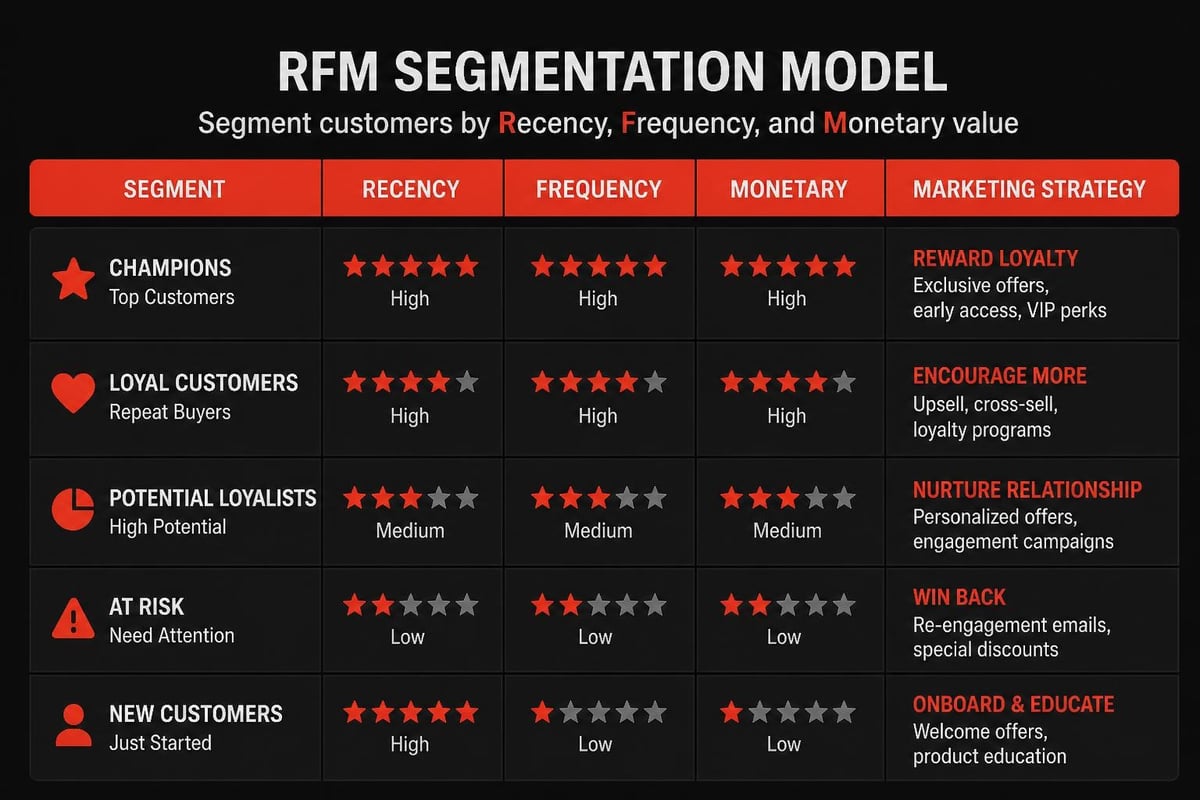
Generic segmentation uses demographic data, firmographics or declared interests. Behavioural segmentation uses actual purchase patterns, which are more predictive of future behaviour and commercial value.
RFM segmentation basics:
- Recency: How recently did they purchase?
- Frequency: How often do they purchase?
- Monetary value: How much do they spend?
Combined, these three dimensions create segments that correlate with retention likelihood and lifetime value. High recency, high frequency, high value customers require different messaging, offers and channel strategies than low-frequency, low-value dormant customers.
When your marketing platforms can calculate and update RFM segments automatically from POS data, you stop treating all customers the same. Email send strategies, offer depth, channel investment and sales prioritisation all become segment-specific.
Advanced segmentation using POS data:
- Product category affinity and cross-category behaviour
- Seasonal purchase patterns and timing
- Price sensitivity and discount responsiveness
- Channel preference (store vs online vs mobile)
- Basket composition and complementary product pairs
- Margin contribution and profitability tier
These segments enable personalisation that feels relevant rather than intrusive. Recommending products based on actual purchase history is more effective than demographic assumptions. Timing offers based on individual replenishment cycles converts better than calendar-based campaigns.
The limitation is data completeness. If only 40% of your customers are identified at POS because the rest check out as guests or staff don’t capture email addresses consistently, your segmentation only works for that 40%. Improving POS data capture becomes a marketing priority, not just an operational detail.
Privacy, Consent and Data Governance
Marketing point of sale systems collect and use personal information and purchase behaviour. That creates privacy obligations under Australian Privacy Principles, GDPR where applicable, and sector-specific regulations.
Core requirements:
- Clear privacy notice explaining how POS data is used for marketing
- Opt-in or opt-out mechanisms depending on jurisdiction and data type
- Secure storage and transmission of customer data
- Access controls limiting who can view purchase history
- Data retention policies and deletion procedures
- Breach notification processes
Many businesses assume that collecting data at point of sale implies consent for marketing use. It doesn’t. Separate consent is usually required, clearly presented and recorded in a way that persists across systems.
When POS data syncs to CRM, marketing automation and advertising platforms, consent status must travel with it. If a customer opts out, that preference needs to suppress messaging across all connected systems, not just the one where they clicked unsubscribe. Building that governance into your data flows prevents compliance violations and customer frustration.
The commercial risk isn’t just regulatory fines. Customers who feel their data is misused stop buying. Using purchase history to send relevant offers builds trust. Using it to spam or share data without permission destroys it.
Operational Challenges and Realistic Expectations
Marketing point of sale sounds straightforward in concept. In practice, it exposes organisational silos, technical debt and process gaps that most businesses would rather ignore.
Common implementation barriers:
- POS managed by operations or finance, not marketing (competing priorities)
- Legacy systems with poor API support or export limitations
- Inconsistent customer data capture across locations or channels
- IT resource constraints and integration backlog
- Lack of clear ownership for data quality and governance
- Budget allocated to campaigns but not to infrastructure
These aren’t technical problems. They’re organisational and strategic problems that require executive sponsorship and cross-functional collaboration to solve. Marketing wants the data. Operations doesn’t want to slow down checkout. Finance wants secure payment processing. IT wants stable systems and minimal custom code.
Getting to a functional marketing point of sale system requires treating it as a strategic initiative, not a feature request. That means defining business outcomes (revenue lift, retention improvement, attribution accuracy), allocating appropriate budget and resources, and assigning clear accountability.
Realistic timelines depend on your starting point. If you have modern cloud-based POS with good API support and a CRM that’s already capturing customer data, you might have basic integration running in weeks. If you’re working with legacy on-premise POS, fragmented customer records and no middleware, expect months.
The payoff is measurable but not immediate. Better segmentation improves campaign performance over time. Attribution data informs budget decisions in future planning cycles. Retention programs built on purchase behaviour take quarters to show ROI. This is infrastructure work that compounds, not a campaign that spikes then fades.
Future Direction and Emerging Capabilities
Marketing point of sale is evolving beyond data integration toward real-time personalisation, predictive modelling and AI-driven activation. The core principle remains: connect transaction reality to marketing decisions.
Emerging capabilities worth watching:
- Real-time personalisation at checkout: Dynamic offers based on basket contents, customer history and inventory
- Predictive replenishment: AI models anticipating reorder timing and automating outreach
- Voice and conversational commerce: POS integration with voice assistants and messaging platforms
- Edge AI in physical stores: On-device processing enabling privacy-preserving personalisation
- Unified identity across channels: Persistent customer profiles that recognise shoppers online and in-store
These capabilities require more sophisticated technical infrastructure and data governance. They also require clarity about what problem you’re solving and whether the complexity delivers proportional value.
Not every business needs real-time personalisation at scale. Many would see better returns from fixing basic data quality problems or implementing simple purchase-triggered workflows that currently don’t exist. The risk is chasing innovation at the expense of getting the fundamentals working reliably.
For established businesses evaluating where to invest in data marketing capabilities, the sequence matters: connect systems, clean data, build basic attribution, test segmented campaigns, measure outcomes, then layer in advanced automation and AI where evidence shows it creates value.
Marketing point of sale creates measurable advantage when transaction data flows reliably into the systems that acquire and retain customers. Most businesses have the data but not the connections, the platforms but not the integration, the intent but not the execution. If you’re ready to audit what’s working, identify the gaps, and build a connected system that turns purchase behaviour into marketing performance, touchpoint.systems provides the technical capability and strategic discipline to make it happen. We connect every platform, fix the data flows others ignore, and measure what actually drives revenue.