
Marketing materials are the assets you use to explain, prove and sell what your business does: brochures, one-pagers, case studies, decks, proposals, landing pages, emails and signage. For a B2B growth team, the useful question is not which ones to produce but which ones move a prospect to the next stage, and whether you can prove it.
Most businesses already have a drawer full of assets. The trouble is that each one was made for a different campaign, by a different person, with no shared tracking. That is how you end up with a polished brochure nobody can connect to a single deal.
This guide covers what to include, how to match each asset to a funnel stage, and how to wire everything together so the numbers mean something.
What Are Good Marketing Materials?
Good marketing materials are assets with a specific job, a specific audience and a measurable outcome. If you cannot say what a piece is meant to make a prospect do next, it is decoration.
The test is simple. For every asset, write one sentence: “This helps [prospect type] decide [specific thing] so they take [specific action].” A case study might help a finance director decide whether a rollout is low risk, so they book a scoping call. A pricing explainer might help a procurement lead justify a shortlist.
Good assets also share a few traits:
- A clear reader. Written for one buyer role, not “everyone in the market”.
- Evidence. Named outcomes, real process detail, specifics a competitor cannot copy by changing the logo.
- One next step. A single call to action, not five.
- Consistency. Same claims, same terminology, same visual identity across marketing and sales.
- Findability. Sales can locate the current version in under a minute.
That last point sounds trivial. It is where most collateral programs quietly fail.
Print and Digital Marketing Materials: Examples by Type
Here are ten print examples and a set of digital ones that cover most B2B needs, grouped by where they tend to be used.
Print and physical examples
- Brochures and capability statements. Useful for trade shows, site visits and leave-behinds in long sales cycles.
- One-page product or service sheets. The thing a champion forwards to their boss.
- Business cards. Still handed over at events. They only matter if the QR code or URL goes somewhere trackable.
- Printed proposals and reports. Sent to senior buyers who print everything anyway.
- Postcards and direct mail. A reasonable account-based tactic for a short target list.
- Flyers and pamphlets. Event handouts and conference bag inserts.
- Banners and pull-ups. Exhibition presence. Plan the URL on them before printing.
- Branded stationery and folders. Proposal packaging that signals care.
- Posters and signage. Reception, showrooms, offices.
- Branded merchandise. Low signal unless tied to a specific campaign and a follow-up.
Digital examples
- Landing pages built for one offer and one audience
- Case studies and customer stories
- Sales decks and proposal templates
- Email sequences and newsletters
- Webinar decks and recordings
- Explainer pages and comparison guides
- Paid ad creative and retargeting variants
- Social posts and short video
Print has not died, and it can still work well for credibility and dwell time. But print is only worth the spend when it connects to something you can measure. A brochure with no unique URL is a brochure you will argue about at budget time.
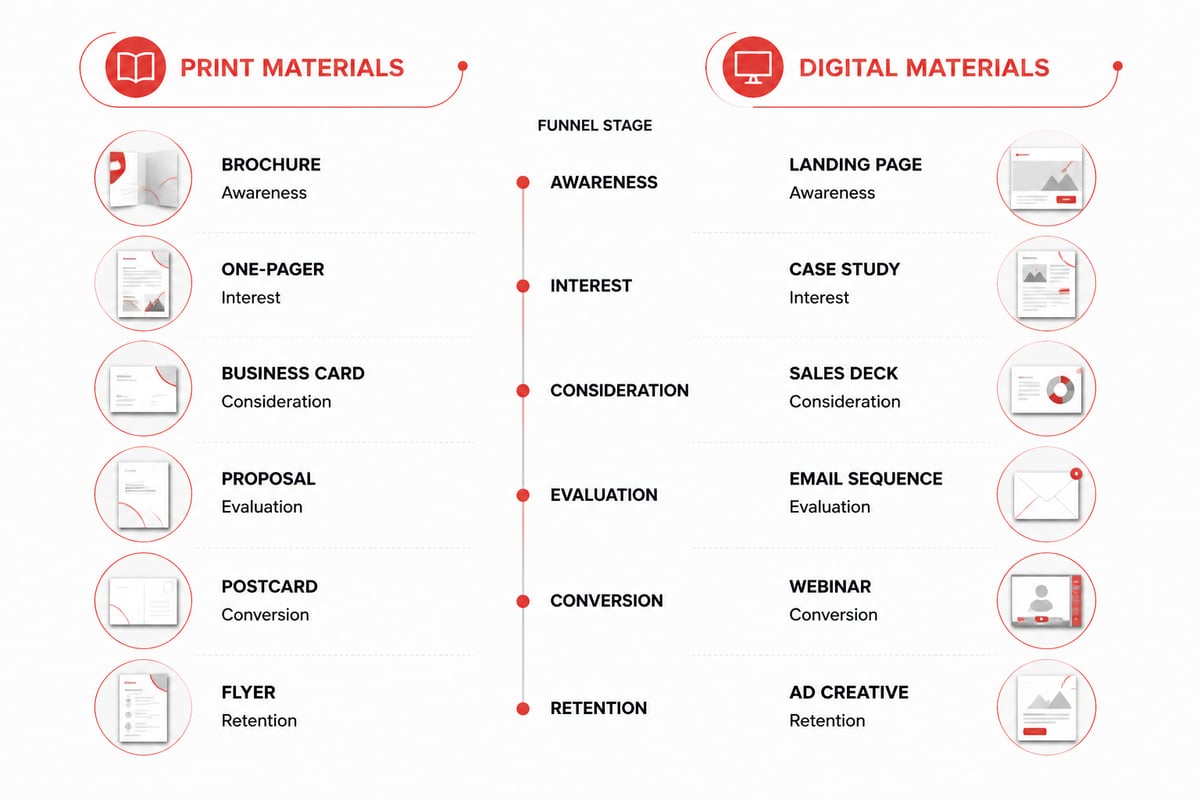
How Do You Choose Which Marketing Materials to Use?
Choose marketing materials by working backwards from the buying journey: identify where prospects stall, then build the asset that removes that specific obstacle.
Start with the stall points, not the asset list. Pull the last 20 won and lost deals from your CRM and note where they slowed down. Usually it falls into a handful of patterns: prospects do not understand what you do, do not trust you yet, cannot justify the cost internally, or cannot see what happens after they sign.
Then map the asset to the stage.
| Funnel stage | Prospect’s question | Asset that answers it |
|---|---|---|
| Awareness | Is this a problem worth solving? | Search-led articles, explainer pages, short video |
| Consideration | Does this company understand my situation? | Case studies, comparison guides, webinars |
| Evaluation | Can I trust them and justify this? | One-pagers, proposals, ROI summaries, references |
| Decision | What happens after I say yes? | Onboarding outline, service terms, implementation plan |
| Retention | Are we getting value? | Reporting templates, review decks, usage emails |
Retention is where most teams under-invest. Existing customers are the cheapest pipeline you have, and a quarterly review deck is a marketing asset like any other.
Before building anything new, audit what you have. A marketing technology audit is a sensible first move because it shows which assets are tagged, which are orphaned and which duplicate each other. Audit before prescription: most businesses need fewer new assets than they think.
What Is the 40-40-20 Rule in Marketing?
The 40-40-20 rule says campaign results come roughly 40 percent from the audience you target, 40 percent from the offer you make, and 20 percent from creative execution. It is a direct marketing rule of thumb rather than a measured law, so treat it as a prompt for where to spend attention.
The practical reading for marketing materials is uncomfortable. Teams usually spend most of their effort on the 20: design polish, copy tweaks, colour choices. The 80 gets less time. A beautifully designed brochure sent to the wrong role with a weak offer will lose to a plain PDF sent to the right buyer with a sharp proposition.
Before commissioning design work, check three things:
- Is the audience defined by role, company type and trigger event, not just industry?
- Is the offer specific enough that a prospect can say yes or no to it?
- Does the asset connect to a lead source you can identify later?
Design still matters. Sales and Marketing Collateral Design from touchpoint.systems treats each asset as having a defined role in the customer journey, kept consistent across marketing and sales, which is the right order of operations: purpose first, polish second.
Why Marketing Materials Fail Without Connected Systems
Marketing materials fail when they sit outside the systems that track prospects, because you cannot tell which asset influenced which deal. Activity looks busy, and revenue attribution stays a guess.
The symptoms are familiar:
- Sales uses a deck from 2024 because nobody told them there is a new one.
- Marketing reports downloads while sales reports “no leads from marketing”.
- Two assets make contradictory claims about the same service.
- A case study drives traffic, but the form does not write to the CRM with a source.
- Print pieces point to a homepage, so offline influence disappears.
Every one of these is a plumbing problem rather than a creative problem. When your CRM, advertising platforms, analytics, email and sales tools do not share data, each asset lives in its own silo and gets judged on its own vanity metric. That is the core argument for connected marketing and campaign systems: the asset, the channel, the lead record and the revenue outcome should be one traceable line.
Technology is a tool here, not a trophy. A big platform stack with inconsistent naming and untagged links is worse than a modest stack used with discipline.
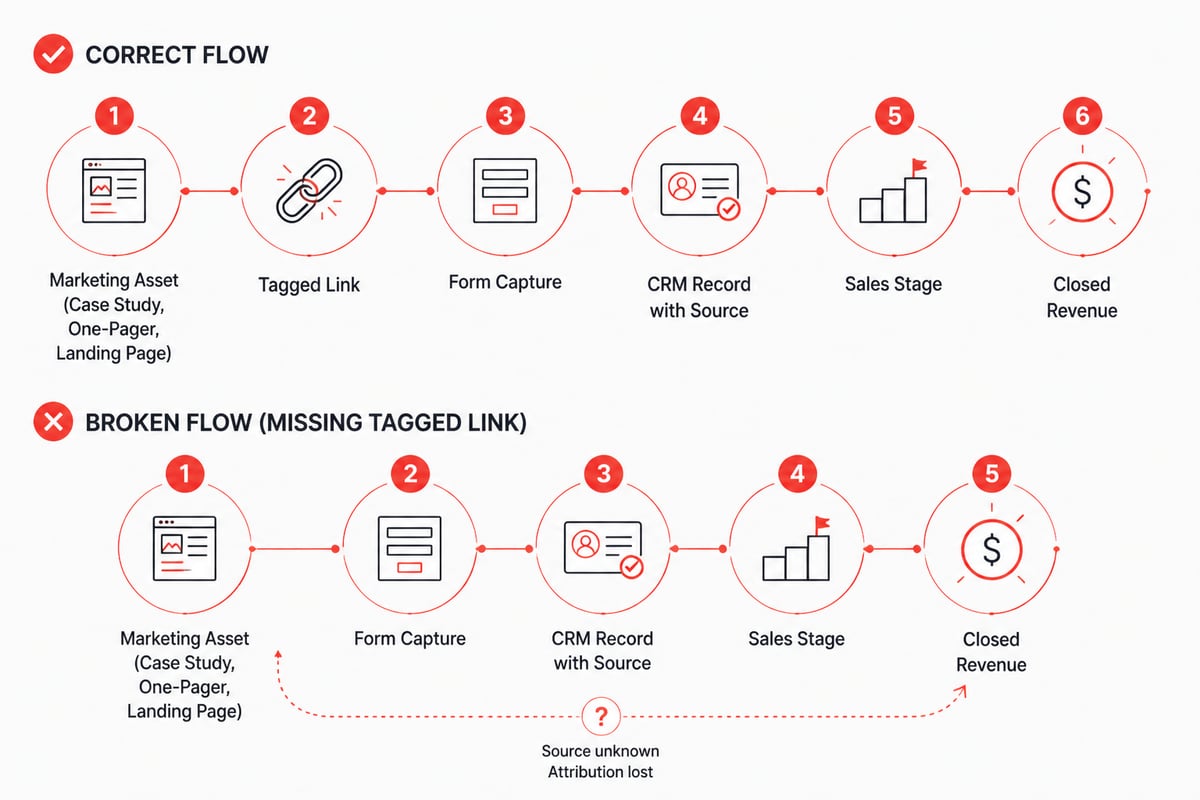
How to Track Marketing Materials So They Produce Pipeline
Track marketing materials by giving every asset a unique, consistently tagged link and making sure that tag reaches the CRM record. This is what turns “we sent a brochure” into “this brochure sourced three opportunities”.
Google Analytics recommends adding campaign parameters to destination URLs, using utm_source, utm_medium and utm_campaign to identify the referring source, medium and campaign. The same guidance notes that utm_content can differentiate creatives or links, such as two separate calls to action inside one email, and utm_term can identify a paid keyword.
A workable convention looks like this:
- utm_source: where the click came from (newsletter, linkedin, event-brochure)
- utm_medium: the channel type (email, paid-social, print-qr)
- utm_campaign: the initiative (q1-erp-migration, partner-launch)
- utm_content: the specific asset or variant (case-study-logistics, cta-top)
A few rules keep this honest:
- Write the convention down and enforce it. Mixed capitalisation creates duplicate rows in your reports.
- Use a dedicated landing page or short URL for each print piece, so offline influence has somewhere to land.
- Pass the parameters into hidden form fields so the CRM stores them against the contact.
- Report on pipeline and revenue by asset, not just clicks.
Tagging is also where data and measurement work pays off. If your analytics, CRM and ad platforms each tell a different story, fix the data layer before buying more creative. A plain-English analytics layer such as AI Insights 365 can help teams query connected data without waiting on a report build, provided the underlying tagging is clean.

Design and Accessibility Standards Worth Enforcing
Marketing materials should meet basic accessibility standards because unreadable collateral is also ineffective collateral. Low contrast and tiny type cost you attention from exactly the senior readers who skim on phones and tablets.
The W3C’s WCAG 2.2 sets a minimum contrast ratio of 4.5:1 for normal text and 3:1 for large text, subject to listed exceptions. It is written for the web, but it is a sound check for PDFs, decks and ad creative too. Grey text on a pale background looks refined in a design review and unreadable on a conference-room projector.
A short checklist for any new asset:
- Contrast checked against the 4.5:1 and 3:1 thresholds.
- One headline claim a reader can absorb in five seconds.
- Consistent terminology with your website and sales scripts.
- A single call to action with a tracked destination.
- A file name and version date, so sales can tell what is current.
- Alt text and readable structure on any digital version.
Search visibility matters too. Case studies, explainers and comparison guides are the assets most likely to be found and cited, which makes them worth structuring carefully. The thinking in this approach to SEO in 2026 applies directly: build assets around questions buyers actually ask, with answers that stand on their own.
Building a Reusable Asset Library
A reusable asset library is a governed set of current, approved marketing materials that sales and marketing both pull from, with an owner, a naming system and a review date for each item. It stops teams rebuilding the same one-pager every quarter.
Start small. A lean library for a B2B team might hold:
- A core capability overview
- Three to five case studies by industry or use case
- A proposal template with swappable sections
- A sales deck with locked claims and editable examples
- Email templates for each funnel stage
- Landing page templates
- A reporting or review template for existing customers
Each item needs an owner, a purpose line, a UTM convention and a review date. Retire anything unreviewed for a year. If your team lacks the capacity to run this internally, an outside digital team such as Kreative Angle can handle production, while the governance, tagging and CRM wiring stay with whoever owns your revenue data. Whoever builds, keep one rule: no asset ships without a tracked destination.
AI can speed up drafting and variation, but treat output as a first draft. Editing for accuracy, tone and your actual claims is still your job, and tools like Mask AI can help smooth text that reads stiffly, though they cannot supply evidence you do not have.
FAQ
What are the top marketing products for a B2B business?
For B2B, the highest-value items are case studies, a clear one-page overview, a sales deck, proposal templates, tracked landing pages and email sequences. Physical items such as banners, brochures and merchandise only earn their place when tied to an event or account-based campaign with a trackable follow-up.
How many marketing materials does a business actually need?
Fewer than most teams produce. Aim for one strong asset per funnel stage and per major buyer role, then add variants only where the data shows a stall. A small, current, well-tagged library beats a large one nobody can find.
Is print still worth it for B2B marketing materials?
Yes, in specific cases: trade shows, account-based mail and senior buyers who prefer paper proposals. Give every print piece a unique URL or QR destination with campaign tagging, otherwise you will never know whether it contributed to pipeline.
Pull your last 20 closed deals, list every asset each prospect touched, and mark the ones that carried a tracked source into your CRM; the gaps will tell you what to fix before you design anything new. If you want help with the assets themselves, Sales and Marketing Collateral Design covers presentations, proposals and reusable templates built for a defined role in the customer journey. If the gap is in the plumbing between your tools, touchpoint.systems audits, designs, builds and manages integrated growth systems that connect your CRM, advertising, analytics, email and sales into one measurable line from asset to revenue.