
Most businesses treat marketing collateral as an afterthought. A quick PDF knocked together before a trade show. A slide deck copied from last year’s pitch. A product sheet that no one can find when they need it. Then they wonder why their marketing feels disconnected and their sales team keeps reinventing the wheel. Marketing collateral isn’t decoration. It’s the collection of assets that explains what you do, demonstrates how you solve problems, and gives prospects the information they need to make decisions. When it’s done properly, collateral becomes the reusable foundation that supports every customer conversation across marketing and sales.
What Marketing Collateral Actually Includes
The term covers any tangible or digital material used to communicate value and support the customer journey. That includes everything from brochures and case studies to videos and proposals.
Physical vs Digital Assets
Traditional printed collateral still has a role in some industries, but most businesses now operate in a primarily digital environment. The distinction matters less than understanding what each asset is designed to achieve.
Physical collateral includes:
- Brochures and flyers
- Business cards
- Product catalogues
- Signage and banners
- Direct mail pieces
Digital collateral includes:
- PDF downloads and ebooks
- Case studies and white papers
- Sales presentations and pitch decks
- Product sheets and one-pagers
- Email templates
- Video explainers and demos
- Web pages and landing pages
- Proposals and contracts
The real question isn’t format. It’s whether the asset has a clear purpose, fits into a connected system, and can be measured.
The Difference Between Marketing and Sales Collateral
People use the terms interchangeably, but there’s a useful distinction. Marketing collateral typically supports top-of-funnel awareness and interest. Sales collateral is designed to help close deals and enable the sales process.
| Purpose | Marketing Collateral | Sales Collateral |
|---|---|---|
| Goal | Generate awareness, interest, leads | Support decision, overcome objection, close |
| Audience | Broader prospects, cold traffic | Qualified prospects, active conversations |
| Examples | Blog posts, social content, ads, guides | Proposals, ROI calculators, product demos, contracts |
| Tone | Educational, informative, accessible | Specific, persuasive, commercially focused |
| Distribution | Website, social, email campaigns, ads | Sales meetings, pitch decks, follow-up emails |
In practice, the line blurs. A detailed case study might start as marketing content and become a powerful sales tool. The point is to understand what job each asset is doing and where it fits in the journey. Salesforce describes this alignment as essential to B2B selling in 2026.
Why Most Collateral Fails
The assets exist, but they’re not working. Common problems include:
- No clear purpose. The piece was created because “we need a brochure,” not to achieve a specific outcome.
- Disconnected messaging. Marketing says one thing, sales says another, the website says something else.
- Impossible to find. Collateral lives in someone’s hard drive, a shared folder no one updates, or multiple conflicting versions scattered across teams.
- Never updated. Pricing, features, case studies and claims become outdated while the old PDF keeps circulating.
- No measurement. No one knows if prospects actually read it, share it, or act on it.
These aren’t creative failures. They’re system failures.
Building Collateral That Supports Connected Systems
Effective marketing collateral sits inside a broader marketing and growth system where every asset has a defined role, consistent messaging, and measurable outcomes.
Start With Strategy, Not Design
Before anything gets written or designed, define:
- What problem does this asset solve? (For the prospect or the sales team)
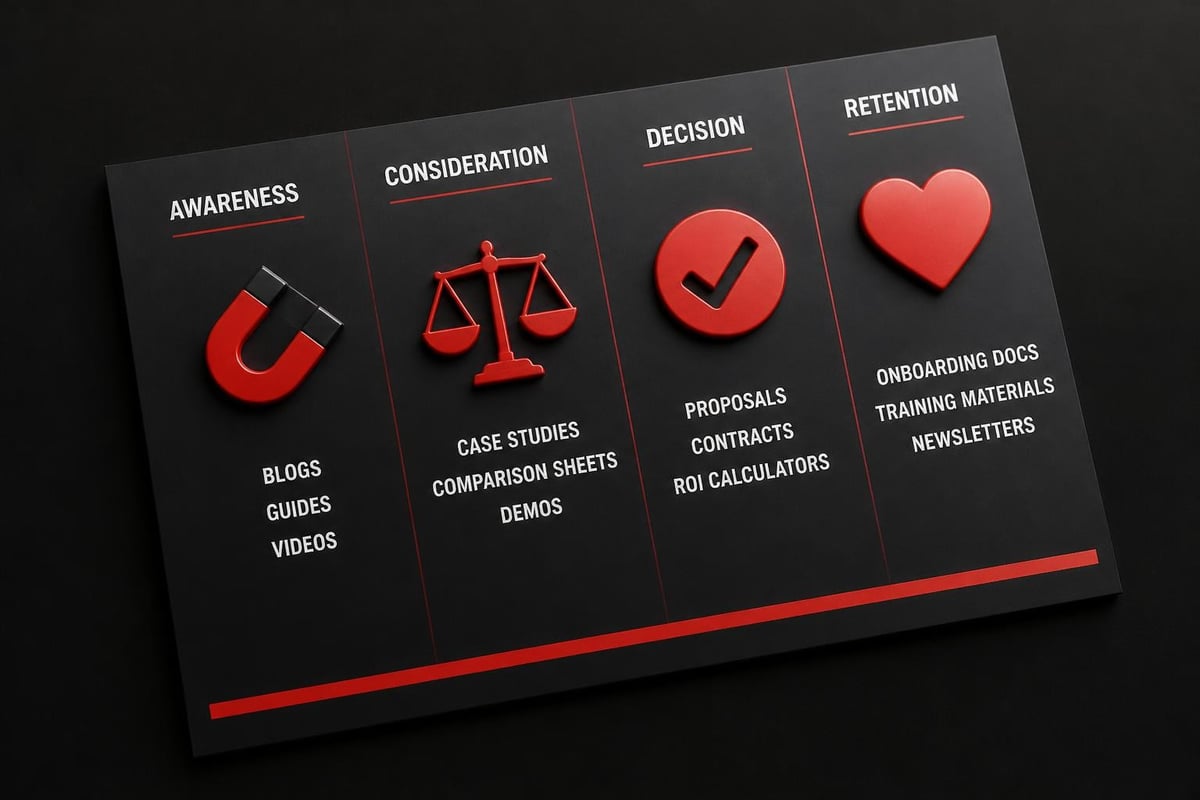
- Where does it appear in the customer journey? (Awareness, consideration, decision, retention)
- What action should it drive? (Download another resource, request a demo, sign a contract)
- Who is responsible for keeping it current? (Owner, review cycle, version control)
Answer those questions first. Then write and design accordingly.
Create Reusable Components
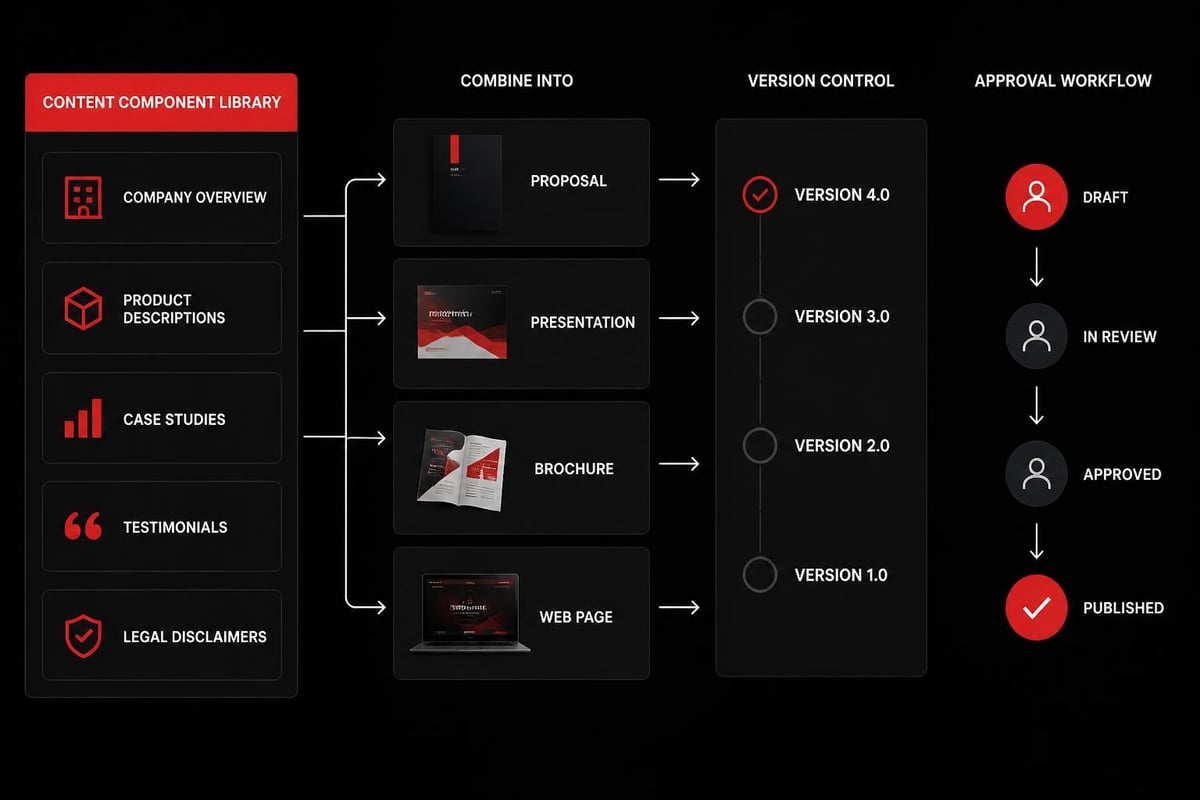
Rather than starting from scratch every time, build a library of modular content blocks that can be assembled into different formats:
- Standard company overview (100, 250, 500 words)
- Product or service descriptions
- Key differentiators and value propositions
- Case study summaries
- Testimonials and quotes
- Founder or team bios
- FAQ responses
- Legal disclaimers and terms
These components live in a central repository. When someone needs a proposal, presentation, or one-pager, they pull the current approved version rather than rewriting or copy-pasting from memory.
Organising and Governing Your Collateral
A pile of PDFs isn’t a system. Collateral needs structure, naming conventions, version control, and access rules.
Central Repository Requirements
Your collateral library should support:
- Search and tagging. Find assets by topic, format, audience, campaign, or journey stage.
- Version control. Know which version is current, who approved it, and what changed.
- Access permissions. Marketing, sales, and partners see what they’re authorised to use.
- Usage tracking. Understand which assets are being downloaded, shared, and viewed.
- Expiry dates. Flag or remove outdated materials automatically.
This isn’t theoretical. Sales enablement platforms exist specifically to solve this problem. But you don’t need enterprise software to implement basic governance. A well-organised shared drive with clear naming conventions and a simple review process is better than nothing.
Naming Conventions That Work
Filenames matter more than you think. A clear naming structure makes assets findable and prevents duplicate or outdated versions from circulating.
Example structure:
AssetType_AudienceOrCampaign_Topic_Version_Date.ext
Actual filenames:
CaseStudy_Manufacturing_AutomationROI_v2_2026-09.pdfPresentation_SalesEnablement_ProductOverview_v1_2026-10.pptxOneSheet_FinancialServices_CRMIntegration_v3_2026-08.pdf
Consistent naming reduces confusion, speeds up search, and makes version control visible at a glance.
Connecting Collateral to Customer Data
Static collateral is better than nothing, but connected collateral is better than static. When assets are linked to CRM, marketing automation, and analytics, you understand how they perform and who engages with them.
Tracking Engagement and Attribution
Digital collateral can and should be measured:
- Downloads: Who requested the asset, when, and from what source?
- Views: How long did they spend reading or watching?
- Shares: Did they forward it or share on social?
- Conversions: Did engagement with this asset correlate with deal progression or closed revenue?
This data flows back into your CRM and attribution models. You learn which case studies actually influence decisions, which presentations close deals, and which one-pagers get ignored. That insight tells you what to create more of, what to update, and what to retire. Custom data visualisation makes those patterns visible across your entire collateral library.
Personalising at Scale
Once collateral is connected to customer data, you can tailor it without creating hundreds of unique versions. Merge fields pull in prospect name, company, industry, pain points, or previous interactions. The core content stays consistent; the details adapt.
Example use cases:
- Proposals that auto-populate pricing based on CRM fields
- Case studies filtered by industry or company size
- Presentations that highlight features relevant to the recipient’s role
- Follow-up emails with attached resources based on what the prospect viewed
This isn’t about tricks. It’s about relevance. The prospect gets information that actually applies to them, and your team doesn’t waste time copy-pasting and reformatting.
Designing Collateral for Clarity and Conversion
Good design isn’t decoration. It’s structure that makes information accessible, believable, and actionable. Poor design wastes the reader’s time and undermines trust.
Visual Hierarchy and Scannability
Most people won’t read your collateral word-for-word. They’ll scan for relevance. Design should support that behaviour:
- Clear headings that signal what each section covers
- Short paragraphs that don’t overwhelm
- Bullet points and numbered lists for features, steps, or benefits
- Bold text to emphasise key terms or outcomes
- White space to separate ideas and reduce cognitive load
- Tables or comparison charts for specs, pricing tiers, or feature matrices
Dense blocks of text get ignored. Structured content gets consumed.
Brand Consistency Without Rigidity
Every piece of collateral should feel like it came from the same company. That means consistent use of:
- Logo placement and sizing
- Colour palette
- Typography and heading styles
- Tone of voice
- Image style and quality
But consistency doesn’t mean identical. A pitch deck, a case study, and a product sheet serve different purposes and can use different layouts. What matters is that a prospect encountering three different assets recognises them all as yours. Harvard Business Review research on brand building confirms that consistent brand assets drive long-term equity and customer trust.
For businesses that need commercially focused materials designed to move prospects through the journey, Sales and Marketing Collateral Design builds assets with a clear role in the customer journey and keeps messaging consistent across marketing and sales touchpoints.
Integrating Collateral Into Workflows
Collateral only works if it’s used. That means embedding it into the actual workflows where marketing and sales operate.
Marketing Automation and Nurture Sequences
When a prospect downloads a guide, what happens next? Ideally, they enter a nurture sequence that delivers related collateral based on behaviour and stage:
- Prospect downloads “Introduction to Marketing Systems” ebook
- CRM tags them as early-stage, interested in systems thinking
- Three days later, they receive a case study showing a similar business solving a related problem
- If they open and click, they’re offered a diagnostic or consultation
- If they don’t engage, they’re moved to a longer, educational nurture track
This isn’t complex AI. It’s basic conditional logic built into most marketing automation platforms. The collateral becomes part of a connected journey, not a one-off download.
Sales Enablement and Just-in-Time Access
Sales teams need the right asset at the right moment. That means:
- CRM integration: Attach relevant collateral to deal stages automatically
- Email templates: Pre-written follow-ups with appropriate attachments
- Mobile access: Sales reps can pull up a case study or demo video on a phone during a meeting
- Suggested content: CRM recommends assets based on industry, deal size, or objection type
When finding and sharing collateral takes 30 seconds instead of 30 minutes, it actually gets used. When it doesn’t get used, it’s wasted effort.

Measuring What Matters
Creating collateral is an investment. You should know whether it’s paying off.
Metrics That Actually Tell You Something
Forget vanity metrics. Track outcomes:
| Metric | What It Tells You | Action If Low |
|---|---|---|
| Download-to-MQL rate | How well top-of-funnel collateral qualifies interest | Improve targeting, refine offer, test messaging |
| Asset engagement score | Which materials prospects actually consume | Retire low performers, create more like high performers |
| Collateral-to-meeting rate | How often an asset leads to a sales conversation | Strengthen CTA, improve follow-up sequence |
| Deal velocity by asset | Whether certain collateral shortens sales cycles | Use high-velocity assets earlier, train sales on best use |
| Revenue influenced | Total pipeline or closed revenue that touched the asset | Prioritise updates and promotion of high-ROI collateral |
Measuring this requires connected systems. Your CRM, marketing automation, analytics, and content platforms need to share data. Most businesses have the tools; they just haven’t connected them. That’s a stack interoperability problem, not a collateral problem.
Testing and Iteration
Effective collateral improves over time. Test variables systematically:
- Headlines and subject lines in gated content offers
- CTA placement and wording in presentations and proposals
- Case study formats (narrative vs bullet points, video vs PDF)
- Email attachment types (inline vs downloadable, PDF vs landing page)
- Design layouts for one-pagers and product sheets
Run small tests, measure results, keep what works, discard what doesn’t. Collateral isn’t created once and forgotten. It’s a living system that responds to evidence.
Common Mistakes and How to Avoid Them
Even experienced businesses make predictable errors with collateral. Recognising them early saves time and money.
Mistake 1: Creating Assets No One Asked For
Just because a competitor has a glossy product brochure doesn’t mean you need one. Start with demand. What questions do prospects ask repeatedly? What information does sales need to close deals faster? Build collateral that solves real problems, not imagined ones.
Mistake 2: Treating Collateral as a Creative Project
Design matters, but clarity matters more. A beautifully designed piece that doesn’t answer the prospect’s question is useless. A plain PDF that delivers the right information at the right time is valuable. Prioritise substance, then polish.
Mistake 3: No Ownership or Review Process
Collateral without an owner becomes orphaned. Prices change. Products evolve. Case studies age. If no one is responsible for keeping assets current, they rot. Assign ownership, set review cycles, and enforce version control.
Mistake 4: Building Silos Instead of Systems
Marketing creates one set of collateral. Sales builds another. Partners get a third set. Messaging diverges, branding inconsistencies multiply, and prospects encounter three different versions of your value proposition. Centralise creation and approval. Let sales and partners customise from a controlled library, not start from scratch.
Mistake 5: Ignoring Mobile and Accessibility
Prospects read PDFs on phones. Videos autoplay in email clients. Presentations get forwarded without context. If your collateral doesn’t work on a mobile screen, or if it’s inaccessible to people with disabilities, you’re excluding potential customers. Test on devices and platforms your audience actually uses.
Making Collateral Part of Your Growth System
Marketing collateral isn’t an isolated tactic. It’s one component in a broader system that connects marketing, sales, customer data, and revenue outcomes.
When collateral is:
- Strategically planned around customer journey stages,
- Centrally organised with governance and version control,
- Connected to CRM and automation for tracking and personalisation,
- Designed for clarity and commercial outcomes,
- Integrated into workflows where marketing and sales actually operate,
- Measured and improved based on evidence,
…it stops being a cost centre and starts being a revenue driver.
The businesses that get this right aren’t necessarily the ones with the biggest budgets or the fanciest design agencies. They’re the ones that treat collateral as infrastructure, not decoration. They audit before they prescribe, connect before they campaign, and measure what matters.
Most established businesses already have collateral. The problem is that it’s scattered, outdated, inconsistent, and disconnected from the systems that drive growth. Fixing that doesn’t require starting over. It requires auditing what exists, defining what’s missing, and building the processes that keep everything connected and current. That’s not a marketing project. It’s a systems project.
Marketing collateral works when it’s treated as part of a connected system, not a collection of random PDFs and slide decks. If your collateral is outdated, hard to find, or disconnected from how prospects actually make decisions, you’re leaving revenue on the table. At touchpoint.systems, we audit, design, build, and manage integrated growth systems for established businesses-connecting CRM, automation, analytics, sales, and marketing into one measurable system where every asset has a purpose and every touchpoint drives outcomes.