
Businesses advertising in 2026 get the best results when every channel feeds one connected system, so spend can be traced from the first click to pipeline and revenue. Picking the “best” channel matters less than whether your CRM, ad platforms and analytics agree on what a good lead is and where it came from.
Most B2B companies already run several channels. The problem is rarely a shortage of activity. It is that search, paid social and content each report their own success, and nobody can say which of them produced the deals that closed. This article covers the main advertising types, how to choose between them, and how to wire them together so the numbers hold up in a leadership meeting.
What types of advertising do businesses use?
Businesses advertising today draw on five broad types: search, paid social, video, display and retargeting, and offline or partner channels. Each has a different job in the buying journey, and mixing them up is where budgets go to die.
- Search advertising captures people already looking for a solution. Intent is high, volume is limited by how many people search.
- Paid social creates demand among people who fit your target profile but are not searching yet. LinkedIn and Meta are the usual options for B2B.
- Video builds familiarity and trust, and it feeds retargeting pools.
- Display and retargeting follow up with visitors who did not convert on the first visit.
- Offline and partner channels include events, print, sponsorships and referral arrangements. They are harder to measure, which is exactly why they need tracking discipline.
The money is moving in predictable directions. The IAB and PwC report puts U.S. internet advertising revenue at $258.6 billion in 2024, up 14.9% year over year. Search advertising reached $102.9 billion, growing 15.9%, and digital video advertising reached $62.1 billion, growing 19.2%. Those figures describe the American market, but the direction applies here: competitors are spending more in the same auctions, so sloppy measurement gets more expensive each year.
What is the best advertising method for a business?
The best advertising method for a business is whichever channel reaches your buyers at the moment they are ready to act, and for most B2B companies that starts with search. People typing a problem into Google have already done the hard part of qualifying themselves.
Search is rarely enough on its own, though. Volume is capped by demand that already exists. Once you have exhausted the profitable keywords, growth comes from paid social, video and content that make more people aware of the problem you solve.
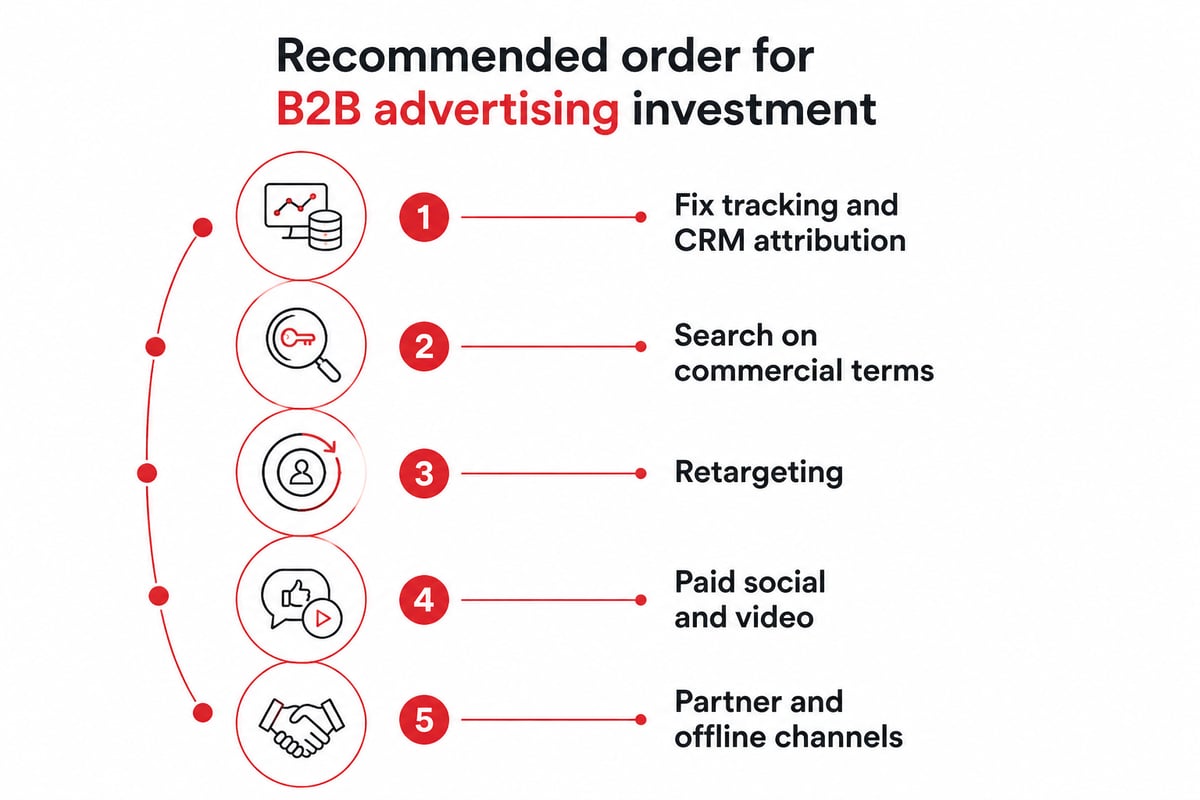
A sensible order for most established B2B businesses:
- Fix tracking and CRM attribution before adding spend.
- Capture existing demand through search on commercial and comparison terms.
- Retarget site visitors and CRM contacts with relevant follow-up.
- Add paid social and video to create demand among likely buyers.
- Test partner or offline channels only when you can attribute them.
Notice that the first step has nothing to do with buying media. If you cannot tell which ads produced pipeline, a bigger budget just produces a bigger unknown.
How do you choose advertising channels for your business?
Choose channels by matching each one to a stage of your sales cycle, then check that you can measure it before you commit budget. A channel you cannot attribute is a guess, however good it feels.
Start with three questions. Who is the buyer and where do they spend time professionally? How long is the sales cycle, and how many people are involved in the decision? What does a qualified lead look like in your CRM, in specific fields rather than a vague feeling?
A short comparison helps frame the trade-offs:
| Channel | Best at | Main limit | What you must track |
|---|---|---|---|
| Search | Capturing active demand | Capped by search volume | Query, landing page, lead status, closed revenue |
| Paid social | Reaching defined audiences | Lower immediate intent | Audience, creative, lead quality, pipeline stage |
| Video | Building trust and recall | Slow, indirect payback | View-through behaviour, retargeting pool performance |
| Retargeting | Recovering lost visitors | Depends on traffic from elsewhere | Assisted conversions, time to close |
| Partner and offline | Warm introductions | Hard to attribute | Source codes, form fields, sales notes |
This is where an audit earns its keep. Before prescribing a channel mix, look at what you already have: which sources produce deals, which produce form fills that go nowhere, and where data drops out between the ad click and the CRM record. A marketing technology audit covers what to assess in your stack, and it is a better starting point than a new campaign.
Why do siloed campaigns waste advertising budget?
Siloed campaigns waste budget because each platform optimises for its own definition of success, and those definitions rarely match your sales team’s. Google Ads counts a form fill. LinkedIn counts a click or a lead gen submission. Your CRM counts a qualified opportunity, and only that last number pays the bills.
Here is a common pattern. A B2B software company runs search and paid social through separate teams. Search reports a low cost per lead. Social reports a high one. Leadership trims social. Meanwhile, the CRM would have shown that social-sourced leads closed at a higher rate and larger deal size, but the data never reached the ad platform. The decision looks rational on the dashboard and is wrong in the business.
The fix is a feedback loop. Offline conversions, such as a lead becoming a sales-qualified opportunity, need to flow back to the ad platforms so they can optimise toward revenue rather than cheap form fills. Google documents this through its conversion measurement guide, which explains how to define valuable actions such as purchases, sign-ups and calls and use that data to judge campaign performance.
This is the thinking behind multi-tier marketing: channels at different levels of the funnel should be designed to hand off to each other, not compete for credit.
How does a connected advertising system actually work?
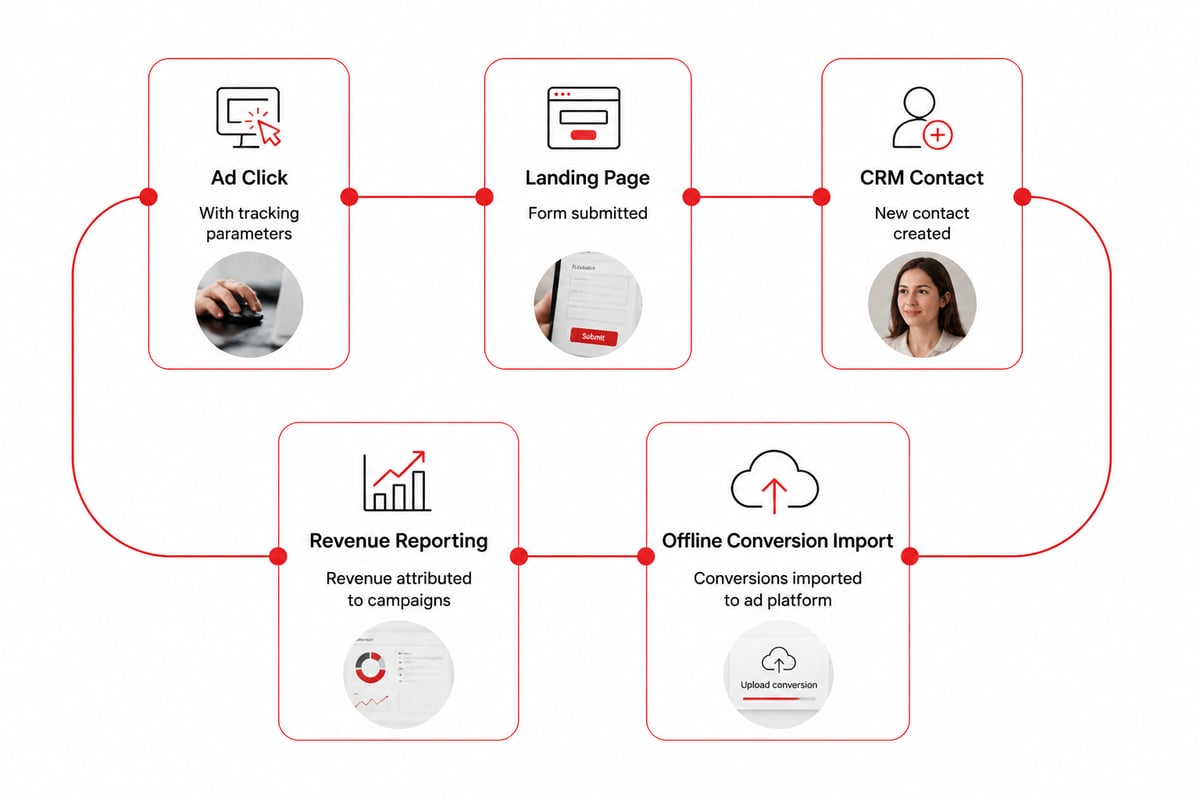
A connected advertising system links your ad platforms, website, CRM, analytics and sales process so that a click, a lead and a closed deal can all be traced to one record. The mechanics are less glamorous than the term suggests.
The core components:
- Consistent tracking parameters on every ad, so source, campaign and keyword survive from click to CRM.
- Form and landing page capture that stores those parameters against the contact, not just in a browser session.
- CRM stages with clear definitions so “qualified” means the same thing to marketing and sales.
- Offline conversion imports that send pipeline and revenue events back to the ad platforms.
- A reporting layer that reads from the CRM as the source of truth, not from each platform’s own dashboard.
Platform choice matters less than people assume. Whether your sales team lives in a CRM like Daylite, a Mac-native option that combines pipeline, email, tasks and projects in one app, or something heavier, the test is the same: can an ad click be traced to a deal? A tool is only useful if the data inside it is clean and connected. Technology should be a tool, not a trophy.
For businesses where the stack has grown by accident, marketing stack interoperability work audits the connections between CRM, advertising, analytics, email and sales tools, and fixes the gaps where data stops flowing.
How do privacy rules and consent affect businesses advertising online?
Privacy rules affect businesses advertising online because consent choices change how much conversion data your ad platforms can see, so measurement has to be designed around consent rather than ignore it. Treating the cookie banner as someone else’s problem leaves holes in your reporting.
Google’s Consent Mode is the main mechanism. It communicates a visitor’s cookie or app-identifier consent status to Google. It works with a consent banner rather than providing one. In the basic implementation, Google tags do not load until the visitor interacts with the banner. Google says Ads and Analytics may have enough data to report Consent Mode uplift after at least seven full days of implementation, so give it about a week before judging results.
Enhanced conversions help fill measurement gaps using first-party data you already hold. Google’s enhanced conversions overview explains how hashed first-party data can support online and offline measurement. The hashing uses SHA-256, and for the API workflow, data can be sent up to 24 hours after a conversion.
None of this is a loophole. It is a way of measuring honestly within what customers have agreed to. Get your privacy and legal advice from the right professionals, then make sure your tag setup, CRM and consent banner all tell the same story.

What should you measure when businesses advertising spend grows?
When spend grows, measure pipeline created, pipeline velocity and revenue by source, not clicks, impressions or platform-reported conversions. Those vanity numbers are easy to inflate and tell you nothing about profit.
A practical measurement set for B2B:
- Cost per sales-qualified opportunity by channel and campaign.
- Lead-to-opportunity rate by source, which exposes channels producing volume without quality.
- Time to close by source, since some channels fill the funnel slowly but close larger deals.
- Customer acquisition cost against customer value, using CRM revenue, not estimates.
- Retention and expansion by acquisition source, because the cheapest customer to win is not always the best one to keep.
That last point is often where ad reporting ends too early. A channel that wins customers who churn in six months looks fine until finance runs the numbers. Connecting advertising data to retention and customer experience turns acquisition spend into a decision about lifetime value.
Resist the urge to measure everything. Pick five numbers leadership will act on, define each in writing, and report them from one source. If two dashboards disagree, the CRM wins.
Where do search, content and AI fit into advertising?
Search, content and AI fit into advertising as the layer that makes paid media cheaper and more effective over time, because they build assets and data you keep after the budget stops. Paid media rents attention. Content and organic search let you own some of it.
Content that answers real buying questions feeds your ads in three ways. It gives paid social something worth promoting to a cold audience, it builds retargeting pools of people who engaged, and it earns organic visibility that reduces dependence on auctions. Landing pages matter just as much: a good ad sending traffic to a slow, generic page is a leak. Purpose-built landing pages keep the message consistent from ad to form.
AI belongs in the system where it saves time or improves decisions, such as scoring leads, summarising sales calls or handling first-line enquiries. A voice or chat assistant like Neuraly can qualify leads and answer questions in multiple languages, which is useful if your ads generate enquiries outside business hours. But automation applied to a broken process just breaks it faster. Fix the handoff first, then automate it.
For the organic side of the picture, the strategic opportunist’s guide to SEO in 2026 covers how search visibility supports the demand your paid channels capture.
What is the 3-3-3 rule in marketing?
The 3-3-3 rule is a loose planning shorthand with no single agreed definition, but it is usually read as three messages, to three audiences, across three channels. The idea is to stay focused rather than spread a budget across everything.
It is a useful constraint, not a law. For a B2B advertising plan, you might apply it like this: three core messages tied to the problems you solve, three buyer roles (the economic buyer, the user and the influencer), and three channels you can measure properly. If you cannot name your three messages and three audiences, adding a fourth channel will not help.
FAQ
What are the different types of advertising used in marketing?
The main types are search, paid social, video, display and retargeting, email, print and broadcast, out-of-home, and direct mail. For B2B companies chasing measurable pipeline, search, paid social and retargeting usually carry most of the load because they are the easiest to attribute.
How much data do I need before judging my advertising?
You need enough conversions and enough time for patterns to appear, which depends on your sales cycle. If your deals take three months to close, a two-week report only shows lead activity, so judge on pipeline stages and revisit closed revenue as it arrives.
Do I need new software to connect my advertising?
Usually not. Most businesses already own the tools they need, and the gap is in how they are connected and configured. An audit of your existing stack will show whether a gap is a missing tool or just a missing link between tools you have.
Pull one month of closed deals from your CRM and check how many can be traced back to a specific ad, keyword or campaign; that gap is your starting brief. If the answer is “not many”, that is a systems problem, and Marketing Stack Interoperability is where touchpoint.systems begins, auditing and connecting the platforms behind your advertising before recommending any new spend. touchpoint.systems audits, designs, builds and manages integrated growth systems for established businesses, platform agnostic and built around how you actually sell. If you want your CRM, advertising, analytics and sales data working as one system, start the conversation at touchpoint.systems.