
Most marketing efforts fail because they’re built as disconnected activities rather than connected systems. An integrated marketing campaign coordinates messaging, channels, data and customer experience across every touchpoint to deliver measurable business outcomes. It’s not about running simultaneous campaigns on different platforms. It’s about building a system where search feeds email, email informs sales, sales data improves targeting, and every channel reinforces the same strategic goal.
The difference matters commercially. Fragmented campaigns waste budget on conflicting messages, duplicate audiences and unmeasurable attribution. Integrated campaigns reduce acquisition costs, shorten sales cycles and provide clear evidence of what drives revenue.
What Defines an Integrated Marketing Campaign
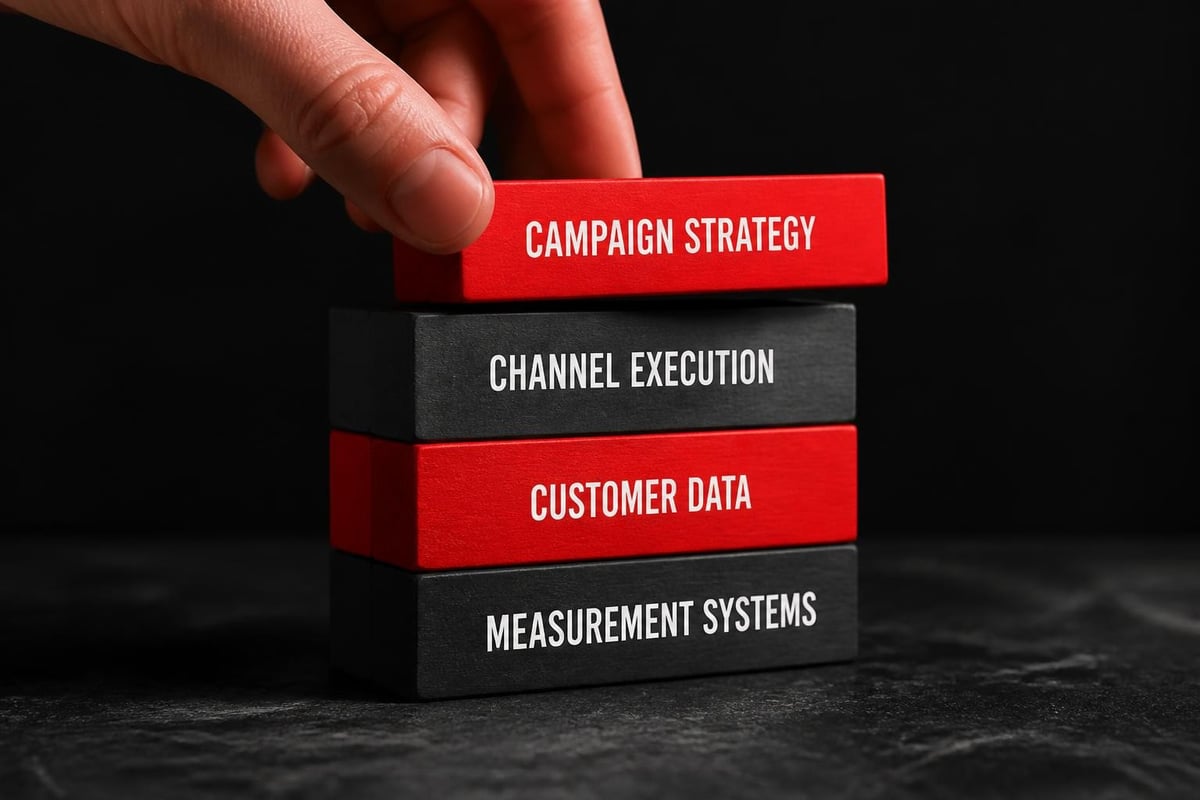
An integrated marketing campaign unifies strategy, execution and measurement across every marketing and sales touchpoint. It treats channels as interconnected parts of one system rather than separate projects managed by different teams with different goals.
Core Components That Must Connect
Every integrated campaign requires four connected elements working together:
- Unified customer data flowing between advertising, website, CRM, email and sales platforms
- Consistent messaging adapted to channel context but anchored to the same positioning and value proposition
- Cross-channel orchestration where each touchpoint advances the same journey rather than competing for attention
- Shared measurement that tracks contribution to revenue, not just channel-specific vanity metrics
The technical foundation matters as much as creative or strategy. If your CRM doesn’t receive lead source data from paid search, if email automation can’t trigger based on website behaviour, or if sales can’t see which content a prospect downloaded, you don’t have integration. You have adjacent campaigns that happen to run at the same time.
Northwestern’s IMC Professional resources provide practical guidance on planning and executing campaigns with proper channel coordination, though they understate the technical infrastructure required to maintain integration at scale.
Why Most Campaigns Fail Integration
Integration fails when organisations prioritise convenience over connection. Marketing teams launch campaigns on platforms they already understand. Sales teams maintain their own outreach sequences. Data sits in disconnected systems. Everyone reports different numbers.
The result is duplicated effort, contradictory messaging and wasted budget targeting the same prospect through three channels that don’t communicate. A prospect might receive cold outreach from sales while simultaneously seeing retargeting ads and being enrolled in a generic nurture sequence, none of which reference the others.
Technical silos reinforce organisational silos. When platforms don’t share data, teams can’t coordinate. When teams don’t coordinate, nobody demands platform integration. The cycle perpetuates itself until someone forces the conversation about marketing stack interoperability.
Building Campaign Architecture That Connects
An integrated marketing campaign requires deliberate technical and operational design before any creative work begins. Start with customer journeys, then map platforms and data flows to support them.
Mapping Data Flow Across Touchpoints
| Source Platform | Data Captured | Destination Platform | Business Use |
|---|---|---|---|
| Paid search | Click, keyword, ad | CRM, analytics | Lead source attribution |
| Website | Behaviour, content | CRM, email, advertising | Retargeting, personalisation |
| Opens, clicks, replies | CRM, sales platform | Engagement scoring, handoff timing | |
| CRM | Stage, score, history | Advertising, sales | Audience suppression, context |
| Sales platform | Calls, meetings, outcomes | CRM, analytics | Revenue attribution, feedback loop |
Every row in that table represents a technical integration that must work reliably. When data doesn’t flow, teams make decisions based on incomplete information or resort to manual exports and reconciliation.
The infrastructure challenge intensifies as campaigns scale. More channels means more integration points. More customer data means more complex identity resolution. More handoffs between systems means more opportunities for data loss or corruption.
Channel Selection Based on Customer Behaviour
Choose channels based on where your customers actually make decisions, not where other companies advertise. An integrated marketing campaign works by meeting prospects in contexts where they’re already paying attention and guiding them through connected touchpoints toward a commercial outcome.
For established businesses selling complex services, this typically means:
- Search (paid and organic) to intercept active research and problem recognition
- Email to maintain engagement and provide depth impossible in advertising
- Sales outreach to handle objections and customise solutions
- Retargeting to recapture attention and reinforce messaging between active touchpoints
The sequence matters. Search generates awareness and initial engagement. Email develops that engagement with educational content and proof. Retargeting maintains presence during consideration. Sales converts when timing aligns with need.
Each channel must know what happened in the others. Sales needs to see which content a prospect consumed. Email needs to pause when a sales conversation starts. Retargeting needs to suppress converted customers and adjust messaging based on engagement stage.
This requires connected growth systems that share customer state across every platform in real time, not just at month-end reporting.
Measurement Beyond Channel Metrics
An integrated marketing campaign demands measurement that reflects how channels work together rather than how they perform in isolation. Last-click attribution and platform-specific metrics obscure the actual customer journey and misallocate budget.
Attribution Models for Connected Systems
Modern attribution acknowledges that most customer journeys involve multiple touchpoints across weeks or months. A prospect might discover you through organic search, return via paid search three times, download a guide, receive six emails, attend a webinar, then convert during a sales call.
Which channel gets credit? All of them contributed. None would have converted alone.
| Attribution Model | Strength | Limitation | Best Use |
|---|---|---|---|
| Last-click | Simple, clear | Ignores journey | Direct response only |
| First-click | Values awareness | Ignores nurture | Brand campaigns |
| Linear | Acknowledges all touchpoints | Oversimplifies influence | Equal-weight journeys |
| Time-decay | Weights recent activity | Arbitrary decay rate | Short sales cycles |
| Data-driven | Uses actual behaviour | Requires volume | High-traffic systems |
| Marketing Mix Modeling | Channel-level incrementality | Needs sustained spend | Strategic allocation |
The IAB’s ‘Modernizing MMM’ best-practices guide addresses how Marketing Mix Modeling must evolve to measure integrated campaign performance across digital and traditional channels, though it requires investment most mid-market businesses won’t justify.
For most established businesses, multi-touch attribution weighted by engagement depth provides sufficient insight. Track every touchpoint in your CRM. Assign fractional credit based on interaction intensity. Measure aggregate channel contribution to pipeline and revenue, not individual conversion paths.

Incrementality Testing Versus Activity Reporting
The critical question isn’t how many clicks or opens you generated. It’s whether your campaign caused additional revenue that wouldn’t have occurred otherwise. Incrementality measurement answers that question through controlled experiments.
Run your integrated marketing campaign in one market or segment while holding it back in a comparable control group. Measure the revenue difference. That’s your incremental impact. Everything else is correlation and assumption.
The IAB’s Guidelines for Incremental Measurement in Commerce Media provide experiment-based and model-based approaches that apply equally to integrated campaigns outside commerce media, though implementation requires statistical discipline many marketers lack.
Incrementality testing is particularly valuable for assessing whether channel integration actually improves performance. Test an integrated campaign against channel-siloed execution with the same budget. Measure acquisition cost, conversion rate, average deal size and customer lifetime value. The operational effort of integration only justifies itself if it demonstrably improves commercial outcomes.
Execution Consistency Across Channels
An integrated marketing campaign maintains strategic coherence while adapting tactical execution to channel constraints and audience context. The core message remains constant. The format, depth and call to action adjust to where someone encounters it.
Message Adaptation Not Message Drift
Write one positioning statement that articulates your differentiated value. Use that statement as the anchor for every piece of content across every channel. Paid search ads highlight one facet. Email expands on another. Sales conversations customise application. But the underlying value proposition never contradicts itself.
Message drift occurs when channel specialists optimise for platform-specific metrics without reference to the broader campaign. The paid search team tests headlines for click-through rate. The email team tests subject lines for opens. The content team writes for SEO. None coordinate. The prospect experiences four different value propositions depending on where they encountered you.
Prevent drift through shared creative briefs, centralised asset libraries and governance that requires approval before channel-specific variations launch. The WARC article on using AI to deliver consistent brand experiences at scale demonstrates how AI-assisted production can maintain creative consistency while producing channel-specific variations efficiently, though it requires clear brand guidelines and quality control.
Workflow Coordination Between Teams
Integration breaks down when teams operate on different schedules with different priorities. Marketing launches a campaign before sales is briefed. Sales changes messaging without informing marketing. Creative assets get produced without considering CRM personalisation capabilities.
Establish shared campaign calendars, regular cross-functional planning sessions and explicit handoff protocols:
- Marketing briefs sales on upcoming campaigns, expected lead volume and qualification criteria
- Sales provides feedback on lead quality, common objections and conversion insights
- Creative and technical teams align on asset requirements, personalisation parameters and platform constraints
- Everyone reviews measurement dashboards showing end-to-end performance, not just their stage
The operational overhead is real. Coordinated campaign planning takes more time than siloed execution. The payoff comes in reduced wasted effort, clearer attribution and faster identification of what’s working.
Infrastructure That Enables Integration
You cannot run an integrated marketing campaign on disconnected platforms managed through manual exports and spreadsheet reconciliation. The technical foundation must support real-time data flow, shared customer identity and cross-platform orchestration.
Platform Requirements for Campaign Integration
Your marketing and sales infrastructure needs:
- CRM as system of record where all customer data, interactions and outcomes centralise
- Identity resolution that matches the same person across website, email, advertising and sales platforms
- Bi-directional data sync between CRM and every channel platform (advertising, email, social, analytics)
- Automation workflows triggered by cross-channel behaviour, not just single-platform events
- Unified reporting pulling data from all platforms into one dashboard or data warehouse
Most businesses underinvest in infrastructure relative to campaign spend. They’ll commit substantial budget to advertising and content production while running campaigns on platforms that barely communicate with each other.
The marketing technology audit identifies gaps, redundancies and integration failures before they undermine campaign performance, though most businesses only conduct one after campaigns have already failed to deliver expected returns.
Infrastructure gaps compound over time. Each new platform adds another integration point. Each workaround creates technical debt. Each manual process introduces error risk. Eventually the system collapses under its own complexity and teams revert to siloed execution because integration became too difficult.
Automation That Maintains Journey Continuity
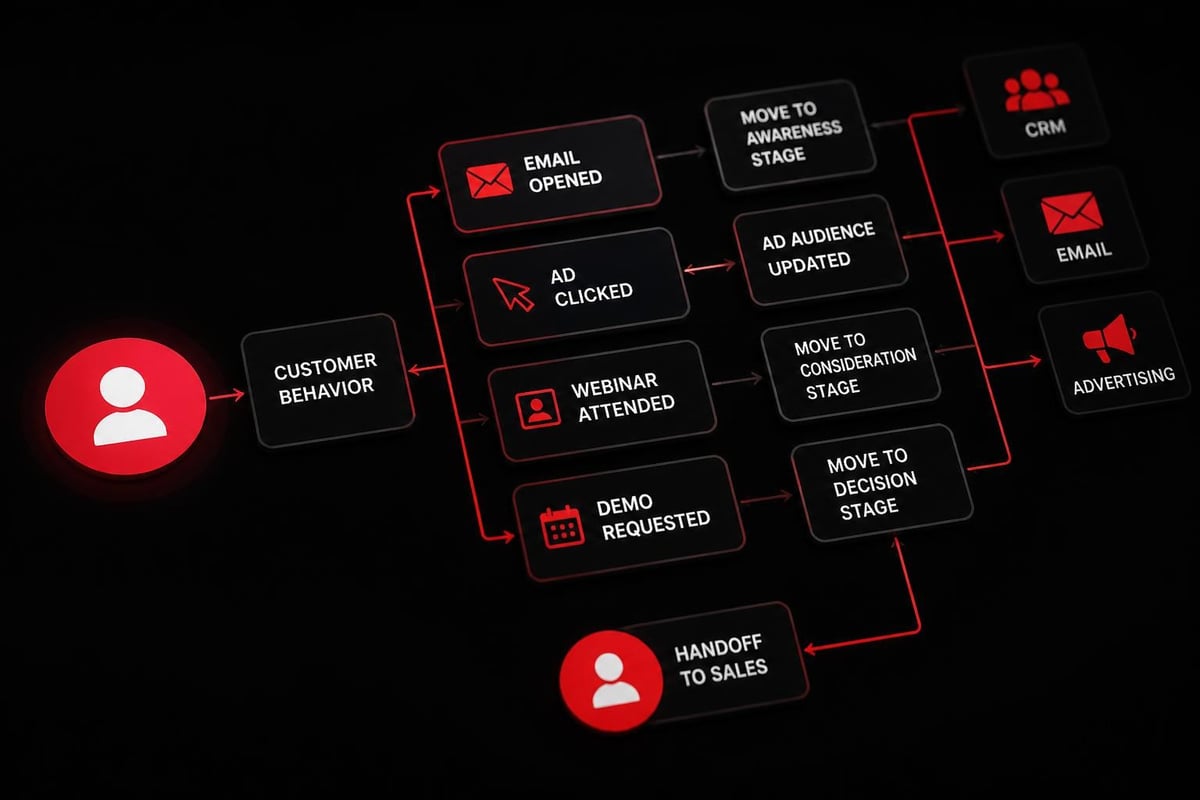
An integrated marketing campaign uses automation to orchestrate customer progression across touchpoints without manual intervention. When someone downloads a guide, they’re tagged in the CRM, enrolled in a nurture sequence, added to a retargeting audience and flagged for sales follow-up if they meet qualification criteria. All automatically.
This requires automation platforms connected to customer data and programmed with business logic that reflects your actual sales process:
- Define journey stages (awareness, consideration, evaluation, decision, retention)
- Map which touchpoints and content suit each stage
- Establish triggers that move customers between stages based on behaviour and engagement
- Configure platform automations that adjust messaging, targeting and sales handoff accordingly
- Monitor for customers who stall, regress or skip stages unexpectedly
The automation handles routine progression. Humans handle exceptions, high-value opportunities and strategic decisions. The division of labour improves both efficiency and effectiveness.
Common Integration Failures and Fixes
Even well-planned integrated marketing campaigns encounter predictable failure modes. Recognise them early and fix the underlying cause rather than treating symptoms.
Data Quality Degradation
Integration depends on accurate, complete customer data. As data flows between platforms, quality degrades through:
- Duplicate records created when different platforms can’t match the same person
- Missing values when fields don’t map cleanly between systems
- Stale information when updates in one platform don’t propagate to others
- Attribution loss when tracking parameters get stripped or corrupted in transit
Fix data quality through regular deduplication, mandatory field validation, scheduled sync monitoring and tracking parameter governance. Appoint someone responsible for data integrity across platforms, not just within their departmental system.
Message Fatigue from Uncoordinated Frequency
When channels don’t communicate, the same prospect receives excessive contact. Retargeting ads appear twenty times daily. Email sequences ignore that someone already responded. Sales calls reach people already in active conversation with another rep.
Implement frequency caps and suppression lists shared across channels:
- CRM-based suppression removes active opportunities from prospecting audiences
- Engagement-based frequency limits reduce contact for people who haven’t responded
- Channel coordination rules prevent simultaneous outreach through multiple channels
- Customer preference controls let people adjust contact frequency and channel mix
The goal is consistent presence without harassment. Integration makes that possible by giving every channel visibility into total contact volume.
Attribution Confusion When Journeys Span Months
Complex B2B customer journeys often extend across quarters. Someone researched in March, engaged in May, evaluated in August and converted in November. Traditional campaign reporting can’t connect those touchpoints because campaign windows ended, budget shifted and teams changed.
Maintain persistent customer-level journey tracking in your CRM regardless of campaign periods. Tag every interaction with campaign source but analyse attribution at the customer level across their entire lifecycle. This reveals actual influence patterns rather than arbitrary campaign-window correlations.
Advanced Integration Opportunities
Once basic campaign integration works reliably, established businesses can explore advanced approaches that further improve performance through tighter connection between channels, systems and customer data.
Privacy-Safe Attribution Through Modeling
Direct tracking grows less viable as browsers block third-party cookies and privacy regulations limit individual-level data collection. Marketing Mix Modeling and synthetic control methods provide aggregate attribution without tracking individuals.
Recent research, including privacy-safe attribution frameworks anchored in MMM, proposes approaches that combine aggregate channel performance data with modeled incrementality to guide budget allocation without compromising privacy. Implementation requires statistical expertise and sustained campaign spend to generate sufficient signal.
For most established businesses, server-side tracking through owned platforms (website, CRM, email) provides sufficient attribution while respecting privacy. Focus on improving data capture on owned properties before investing in complex modeling.
Non-Traditional Channel Integration
An integrated marketing campaign can incorporate channels beyond the standard digital mix when audience behaviour justifies it. Games, community platforms, events and partner ecosystems all provide touchpoints that can connect to core marketing and sales systems.
The Harvard Business Review piece on using games to build customer relationships demonstrates how brands integrate gaming mechanics into broader campaigns to deepen engagement, though the approach works better for consumer brands than most B2B businesses.
Evaluate channel additions based on:
- Where your customers actually spend time (data, not assumptions)
- Whether the channel supports your message complexity (some products can’t be explained in social posts)
- Integration feasibility (can the platform share customer data with your CRM?)
- Incremental contribution (does adding it improve outcomes beyond existing channels?)
Add channels deliberately, integrate them properly, measure incrementality and remove them if they don’t contribute. Integration for integration’s sake wastes resources.
AI-Assisted Campaign Orchestration
Artificial intelligence can optimise campaign orchestration decisions too complex or numerous for manual management. Which email should this prospect receive next? What ad creative suits their engagement pattern? When should sales reach out?
AI-assisted orchestration works when:
- You have sufficient data volume to train models (thousands of customer journeys, not dozens)
- Decisions are frequent, bounded and measurable (next email, not overall strategy)
- Human judgment remains available for exceptions and strategic shifts
- The system explains recommendations rather than operating as a black box
Most established businesses benefit more from properly connecting existing platforms than from adding AI orchestration. Get basic integration working first. Layer intelligence on top once manual processes become the bottleneck.
Practical Implementation Sequence
Start small, prove value, then expand. An integrated marketing campaign doesn’t require transforming your entire marketing operation simultaneously. Begin with two channels and one customer journey, get integration working properly, measure improvement, then add complexity.
Phase One: Foundation (Months 1-3)
- Audit current state: map existing platforms, data flows, customer journeys and measurement gaps
- Choose pilot journey: select one high-value customer segment and journey to integrate first
- Connect core systems: establish reliable data flow between CRM, website and primary acquisition channel
- Establish baseline metrics: measure current performance before integration changes anything
The audit reveals where integration will create most value and what infrastructure gaps must close first. Most businesses discover that their supposed integrations are actually scheduled data exports with 24-hour delays and significant data loss.
Phase Two: Integration (Months 4-6)
- Implement cross-platform identity: ensure the same customer is recognised across website, email, advertising and CRM
- Build automation workflows: create triggered sequences that respond to cross-channel behaviour
- Align messaging: develop coordinated content and creative that maintains consistency across touchpoints
- Launch integrated pilot: run the campaign with full channel coordination and measurement
Expect friction. Systems that supposedly integrate often don’t. Promised features don’t work as documented. Teams resist changing established workflows. Budget the time and political capital to resolve these issues rather than working around them.
Phase Three: Measurement and Optimisation (Months 7-9)
- Gather cross-channel performance data for the complete customer journey, not individual touchpoints
- Calculate incremental impact by comparing integrated performance against siloed baseline
- Identify failure modes: find where integration breaks down, data quality degrades or messages drift
- Optimise weak points: fix the specific integration gaps that cause the largest performance loss
Measurement reveals whether integration actually improved commercial outcomes. If acquisition cost dropped, conversion rate increased or customer lifetime value improved, expand integration to additional journeys. If performance didn’t improve, diagnose why before scaling broken processes.
Phase Four: Expansion (Months 10-12)
- Apply learnings to additional journeys: extend integration to more customer segments and use cases
- Add channels strategically: incorporate new touchpoints where customer behaviour and data justify them
- Deepen automation: hand more routine orchestration decisions to automated workflows
- Refine attribution: improve measurement sophistication as data volume and journey complexity grow
Expansion multiplies both value and complexity. More integrated journeys means more systems to maintain, more data flows to monitor and more coordination between teams. Scale infrastructure and operational discipline alongside campaign scope.
An integrated marketing campaign replaces siloed channel activity with connected systems that share data, coordinate messaging and measure collective contribution to revenue. The operational and technical effort is substantial, but the commercial advantage compounds over time as customer acquisition becomes more efficient and attribution becomes more accurate. If your marketing systems operate as disconnected campaigns rather than integrated journeys, touchpoint.systems audits existing infrastructure, identifies integration gaps and builds connected growth systems that replace fragmented execution with measurable, coordinated customer acquisition and retention.