
Most businesses treat client acquisition like a series of disconnected experiments. They run campaigns, buy ads, post content, attend events, and hope something sticks. When a prospect converts, nobody knows which touchpoint mattered. When they disappear, there's no record of why. This approach burns budget, frustrates sales teams, and makes growth impossible to predict or repeat.
Client acquisition isn't a campaign problem. It's a systems problem. The businesses that grow predictably don't rely on tactics. They build connected systems that capture attention, qualify prospects, nurture interest, and convert opportunities into revenue through measurable, repeatable processes.
What Client Acquisition Actually Means
Client acquisition is the complete process of identifying, attracting, qualifying, converting, and onboarding new customers. It starts before a prospect knows you exist and ends when they've made their first purchase and received what they paid for.
Most definitions stop at conversion. That's a mistake. Acquisition isn't complete until the customer has experienced value. A signed contract with a poor onboarding experience creates a problem, not a customer. The client acquisition system must connect marketing, sales, delivery, and initial customer experience into one accountable process.
The Difference Between Lead Generation and Acquisition
Lead generation captures contact details. Client acquisition turns strangers into paying customers. Lead gen measures form fills, downloads, and enquiries. Acquisition measures revenue, profit, customer lifetime value, and cost per customer.
Too many businesses confuse activity with outcomes. They celebrate a full pipeline while cash flow stagnates. They measure click-through rates while ignoring conversion rates. They count "marketing qualified leads" that sales never touches. Data from the Content Marketing Institute shows most B2B organisations still struggle to connect content activity to actual revenue outcomes.
Client acquisition systems measure what matters: how many prospects entered, how many qualified, how many converted, what it cost, what they're worth, and which parts of the process are breaking.
Why Most Acquisition Efforts Fail
Siloed Platforms and Disconnected Data
Marketing runs ads in one platform. Sales logs calls in another. Website analytics sit separately. Email systems don't talk to CRM. Nobody knows which campaign generated which enquiry or whether that enquiry became a customer.
When platforms don't connect, decisions are made blind. Marketing optimises for clicks that don't convert. Sales chases leads that were never qualified. Budget flows to channels that feel productive but generate nothing measurable.
The problem isn't the individual platforms. It's the lack of integration. Marketing stack interoperability turns fragmented tools into connected systems where prospect behaviour, sales activity, and revenue outcomes flow into a single source of truth.
No Clear Definition of a Qualified Prospect
Most businesses can't define what makes a prospect worth pursuing. Sales complains about lead quality. Marketing defends lead volume. Nobody agrees on the criteria that separate a genuine opportunity from noise.
Without shared qualification standards, acquisition becomes a numbers game. Every enquiry gets the same treatment. High-value prospects wait while sales chases tyre-kickers. Conversion rates stay low because most prospects were never viable in the first place.

Define qualification criteria together:
- Demographic fit: industry, company size, location, role
- Behavioural signals: pages viewed, content consumed, engagement frequency
- Budget authority: ability and willingness to invest
- Timeline: urgency and decision-making process
- Problem-solution alignment: stated need matching your offering
Capture these signals in CRM. Score prospects automatically. Route qualified opportunities to sales. Nurture unqualified prospects until they mature or disqualify themselves.
Campaign-Based Thinking Instead of System Design
Campaigns have start dates, end dates, and isolated budgets. They're planned in silos, measured in silos, and discarded when the calendar runs out. Next month brings a new campaign with different messaging, different offers, and different landing pages. Prospects experience inconsistency. Data fragments across temporary initiatives.
Client acquisition systems replace campaign churn with continuous processes. Messaging stays consistent. Landing pages connect to CRM. Nurture sequences adjust based on behaviour. Attribution tracks the complete journey. When something works, it's systematised and improved, not abandoned for the next shiny tactic.
Building a Connected Acquisition System
Map the Complete Journey
Start by documenting how prospects actually become customers. Not the idealised funnel from a marketing textbook. The messy reality: multiple visits, cross-channel research, conversations with sales, objections, delays, and non-linear decision paths.
Identify every touchpoint where prospects interact with your business:
- Awareness: search, ads, referrals, social, content, events
- Consideration: website visits, content consumption, email engagement
- Evaluation: demo requests, proposal reviews, pricing discussions
- Decision: contract negotiation, internal approvals, objection handling
- Onboarding: welcome sequences, initial setup, early value delivery
Map which platforms and people handle each stage. Identify where data is lost, where prospects disappear, and where handoffs break. This becomes your baseline for systematic improvement.
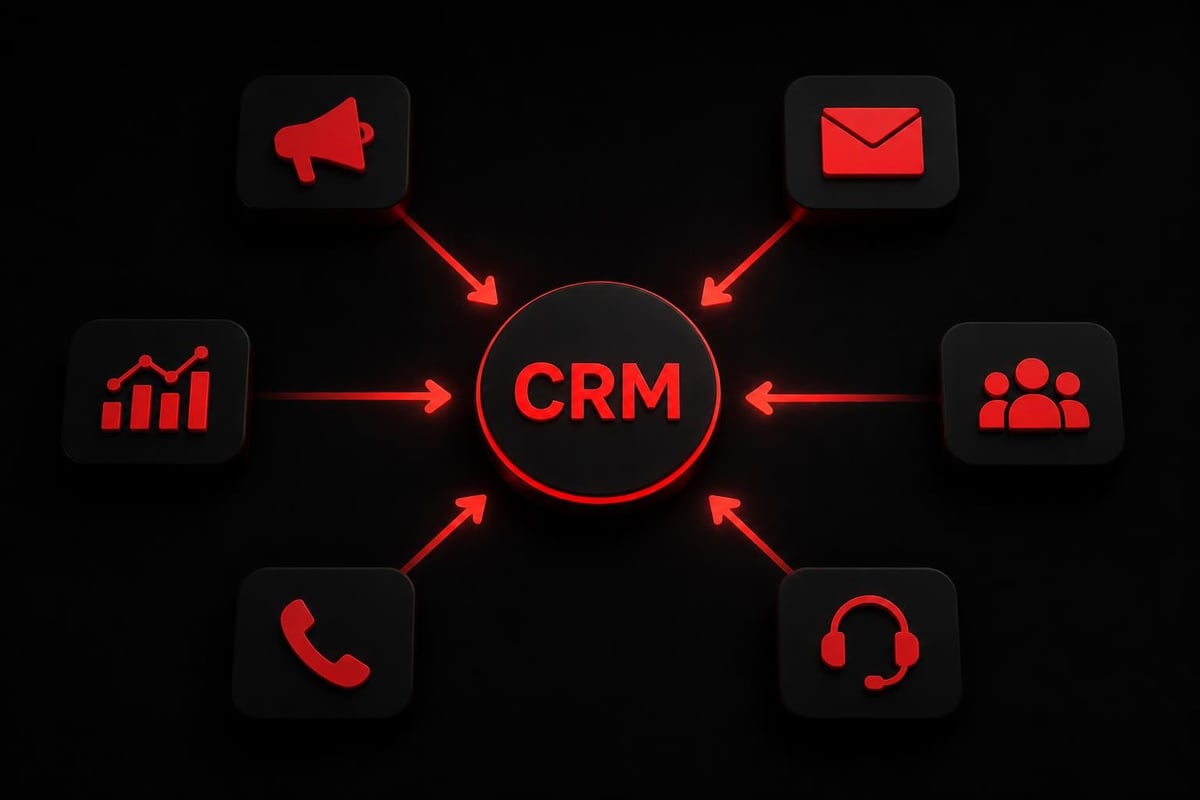
Connect Every Platform to CRM
Your CRM is the operational system of record for client acquisition. Every prospect interaction, regardless of channel, should create or update a CRM record. Every platform that touches prospects must connect to CRM through native integrations, APIs, or automation.
| Platform Type | Data to Capture | Why It Matters |
|---|---|---|
| Website analytics | Pages viewed, time on site, returning visits | Shows intent and research depth |
| Advertising platforms | Ad clicked, keyword, campaign source | Attributes cost to specific prospects |
| Email systems | Opens, clicks, replies, unsubscribes | Measures engagement and nurture effectiveness |
| Social platforms | Profile visits, message exchanges, content interactions | Tracks relationship building |
| Sales tools | Calls logged, meetings scheduled, proposals sent | Documents progression and objections |
| Support systems | Questions asked, problems raised, resolution time | Reveals concerns during evaluation |
When platforms connect, the complete acquisition story lives in one place. Marketing can see which campaigns generate customers, not just clicks. Sales knows which content prospects consumed before the call. Leadership understands true cost per customer and channel ROI.
Automate Qualification and Routing
Manual qualification wastes time and introduces inconsistency. One salesperson's "hot lead" is another's "not interested." Prospects wait days for responses while team members debate priority.
Automated qualification uses behavioural data and explicit criteria to score prospects and route them appropriately:
- High-intent behaviours (pricing page visit, demo request, multiple return visits): immediate sales notification
- Medium engagement (content downloads, email clicks, single site visit): nurture sequence with educational content
- Low engagement or poor fit (wrong industry, out-of-region, student email): polite disqualification or long-term nurture
Automation doesn't replace judgement. It ensures qualified prospects reach sales quickly while others receive appropriate follow-up without manual sorting.
Build Nurture Sequences That Respond to Behaviour
Most email nurture is calendar-based: send email one on day zero, email two on day three, email three on day seven. Behaviour is ignored. Someone who clicked every link gets the same timing as someone who never opened an email.
Behavioural nurture adjusts based on engagement. High engagement accelerates progression toward sales contact. Low engagement pauses or shifts to different content. Specific actions trigger relevant follow-up.
Example sequence logic:
- Prospect downloads industry guide → Wait 2 days → Send related case study
- If case study opened → Wait 1 day → Invite to webinar or offer consultation
- If case study ignored → Wait 7 days → Send different angle or educational content
- If webinar attended → Immediate sales notification for personal outreach
- If webinar skipped → Continue educational sequence, reduce frequency
This creates relevant experiences while identifying who's genuinely interested versus passively curious.
Measuring What Actually Matters
Cost Per Customer, Not Cost Per Lead
Marketing celebrates cost per lead. Finance cares about cost per customer. The gap between these numbers reveals system efficiency.
If your cost per lead is fifty dollars but only one in twenty leads converts to a customer, your true acquisition cost is one thousand dollars. Optimising cost per lead without measuring conversion rate makes the metric meaningless. You can generate cheaper leads that never convert and call it success.
Track the complete funnel:
- Prospects generated (by channel)
- Qualified prospects (meeting defined criteria)
- Opportunities created (sales-accepted)
- Customers won (revenue generated)
- Cost per stage
- Conversion rate between stages
- Time in each stage
Mixpanel’s benchmark data shows significant variation in conversion performance across channels and industries. Know your numbers. Compare them to realistic benchmarks, not aspirational case studies.
Channel Attribution That Reflects Reality
First-click attribution gives all credit to initial awareness. Last-click gives it to the final touchpoint. Both are wrong. Client acquisition is multi-touch. Prospects research across channels, over time, through multiple interactions.
Attribution models should reflect your actual sales cycle:
| Attribution Model | Best For | Limitation |
|---|---|---|
| First-touch | Short cycles, single-touch sales | Ignores nurture and conversion effort |
| Last-touch | Simple tracking, direct response | Misses awareness and consideration channels |
| Linear | Equal credit across journey | Oversimplifies varying touchpoint value |
| Time-decay | Longer cycles, relationship sales | May undervalue early awareness |
| Position-based | Complex B2B journeys | Requires sophisticated tracking |
Most established businesses need position-based or custom weighted models. Early touchpoints get credit for awareness. Middle interactions for nurture. Final touchpoints for conversion. The weighting reflects what actually drives decisions in your market. When platforms connect properly, this attribution happens automatically through CRM tracking and custom data visualisation that turns fragmented touchpoint data into clear attribution insights.
Lifetime Value Versus Acquisition Cost
Acquisition cost only makes sense relative to customer value. A five-hundred-dollar acquisition cost is excellent if customers are worth five thousand dollars over their lifetime. It's terrible if they're worth six hundred dollars.
Calculate customer lifetime value properly:
- Average purchase value × purchase frequency × customer lifespan = gross LTV
- Subtract cost of goods sold and servicing costs = net LTV
- Compare to total acquisition cost (marketing + sales + onboarding)
Healthy ratios typically show LTV at least 3:1 versus acquisition cost. Lower ratios mean acquisition is too expensive or customer value is too low. Either improve conversion efficiency, reduce acquisition costs, or increase customer value through retention and expansion.
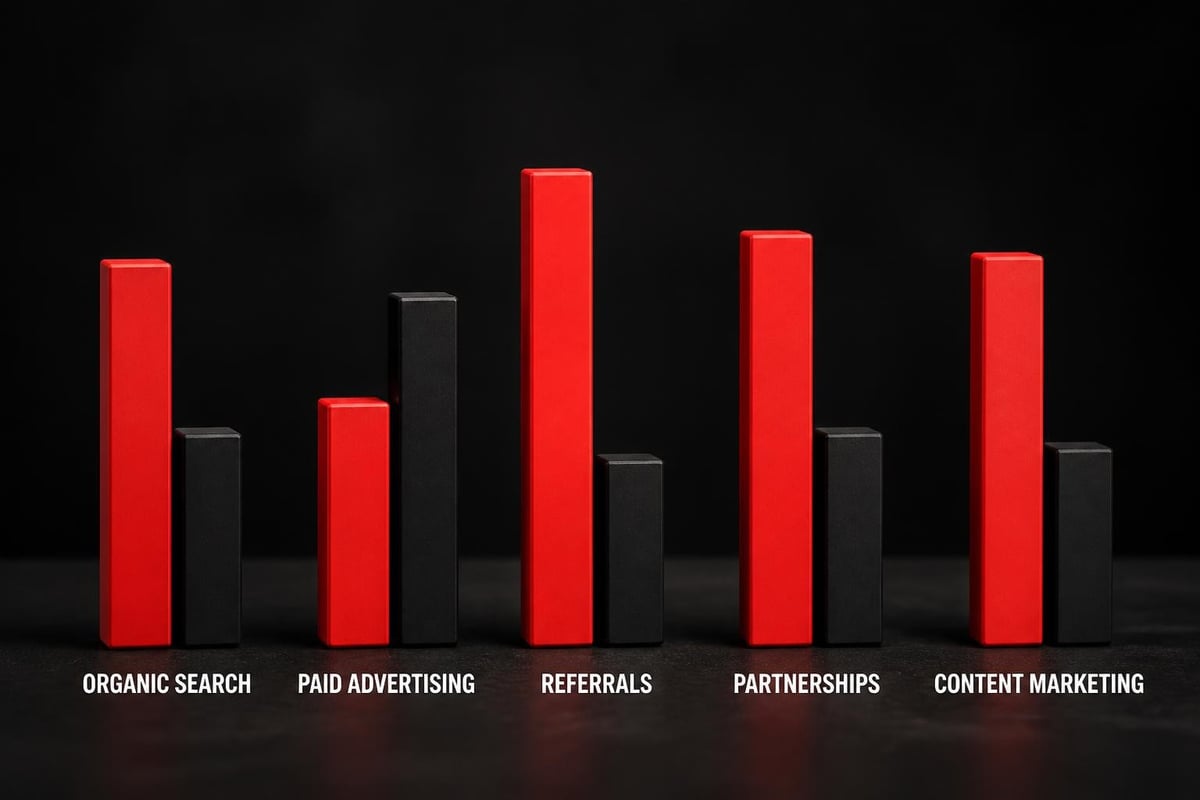
Organic Versus Paid Acquisition
When Paid Acquisition Makes Sense
Paid channels deliver speed and control. Turn on ads, get traffic. Increase budget, get more traffic. Test messaging quickly. Target specific audiences. Scale what works.
WordStream’s Google Ads benchmarks provide realistic expectations for paid search performance across industries. Median conversion rates range from 2% to 5% for most B2B sectors. Cost per click varies significantly by competition and intent.
Paid acquisition works best for:
- New businesses needing immediate visibility
- Seasonal offers with time-limited opportunity
- Competitive markets where organic presence takes years
- Niche targeting requiring precise audience selection
- Testing new markets, messages, or offers quickly
The limitation is ongoing cost. Turn off ads, traffic stops. Sustainable growth requires reducing dependence on paid channels over time.
Building Organic Acquisition That Compounds
Organic acquisition includes search visibility, referrals, word-of-mouth, community presence, and content authority. It's slower to build but compounds over time. Well-ranked content generates enquiries for years. Happy customers refer others continuously. Research from Harvard Business Review demonstrates that referrals create a contagion effect where referred customers are more likely to refer others, multiplying acquisition without proportional cost increases.
Organic search visibility requires technical foundations, content relevance, and authority signals. Google’s SEO documentation emphasises helpful, reliable content created for people, not algorithms. Search acquisition works when you answer questions prospects actually ask, match their search intent, and demonstrate expertise.
Balance paid and organic based on growth stage, competitive position, and margin structure. Early-stage businesses often start paid-heavy and gradually shift investment toward organic compounding. Established businesses with strong margins may maintain paid presence while building organic authority.
The Role of Sales in Client Acquisition
Marketing generates attention and qualifies prospects. Sales converts interest into revenue. The handoff between these functions determines acquisition efficiency.
Lead Handoff Process
Define exactly when marketing hands prospects to sales:
- Trigger criteria: specific behaviours, score thresholds, or explicit requests
- Data included: prospect history, engagement summary, qualification details
- Expected response time: immediate for high-intent, scheduled for medium engagement
- Feedback loop: sales reports lead quality, outcome, disqualification reasons
When this process is systematic, qualified prospects receive fast, informed outreach. Marketing learns which sources and signals predict conversion. Sales stops wasting time on poor-fit enquiries.
Sales Enablement Through System Design
Sales effectiveness improves when systems provide context and automation:
- Prospect history visible in CRM: sales knows what content was consumed, which emails were opened, how many visits occurred
- Automated scheduling: prospects book meetings directly without email tennis
- Templated outreach: proven messaging available for common scenarios
- Proposal automation: customer details, pricing, and terms generated from CRM data
- Follow-up reminders: system prompts next actions based on stage and time elapsed
This isn't about replacing sales judgement. It's about eliminating friction, providing context, and ensuring consistent execution of proven approaches.
Common Acquisition Mistakes to Avoid
Optimising for Vanity Metrics
Traffic, impressions, followers, and engagement feel productive. They're easy to increase and pleasant to report. They also bear minimal relationship to revenue.
Optimise for commercial outcomes: qualified prospects, conversion rates, customer acquisition cost, revenue, and profit. If traffic doubles but conversions stay flat, traffic growth is irrelevant. If engagement increases but enquiries decrease, engagement is the wrong focus.
Ignoring Existing Customer Acquisition Costs
The DMA’s research on customer data value shows most businesses under-invest in data quality and attribution, leading to invisible acquisition costs. When you can't measure cost per customer accurately, budget allocation is guesswork.
Implement tracking before increasing spending. Know current acquisition costs by channel before scaling. Test incrementally and measure actual outcomes, not projected returns.
Treating Acquisition as a Department Instead of a System
Acquisition isn't marketing's job. It's a cross-functional system involving marketing, sales, delivery, and customer success. When departments optimise their own metrics without regard for the complete process, the system breaks.
Marketing generates leads that sales can't close. Sales promises delivery can't fulfil. Onboarding creates friction that cancels early enthusiasm. The customer experiences disjointed interactions that don't match expectations.
Fix this through shared accountability for customer outcomes. Measure marketing by customers acquired, not leads generated. Measure sales by revenue and customer satisfaction, not just deals closed. Align incentives to the complete acquisition result.
Chasing New Channels Before Fixing Core Systems
New platforms appear constantly. Each promises untapped audiences and competitive advantage. Most businesses chase novelty before optimising what they already have.
Fix your website conversion before testing new traffic sources. Connect your CRM before adding more platforms. Improve your sales process before scaling lead volume. New channels amplify what you already do. If your conversion process is broken, more traffic just reveals the break faster.
Client acquisition becomes predictable when it's treated as a connected system rather than a collection of campaigns. The businesses that grow sustainably build integrated processes where every platform, touchpoint, and team member contributes to measurable customer outcomes. If your acquisition efforts feel like constant experimentation with inconsistent results, the problem isn't tactics or budget. It's the absence of a connected system that captures, qualifies, nurtures, and converts prospects reliably. touchpoint.systems audits your complete acquisition process, identifies where revenue is being lost, and builds the integrated systems that turn client acquisition from guesswork into a repeatable growth engine.