
Most marketing tips focus on tactics. Run more ads. Post more content. Try the latest platform. But established businesses don’t need more activity-they need systems that connect marketing effort to measurable outcomes like enquiries, sales, revenue and profit. The difference between busy marketing departments and effective ones is rarely the volume of work. It’s whether the work is connected, measurable, and designed to compound.
Start With Audit, Not Activity
The first marketing tip that matters: understand what you already have before adding more. Most businesses operate marketing in silos. The CRM doesn’t talk to the advertising platform. Email campaigns run independently of sales follow-up. Analytics tools collect data that nobody uses to make decisions.
Before prescribing new campaigns or tools, audit what exists. Map every platform, process, customer touchpoint, and data flow. Identify where prospects enter, where they drop off, and where information disappears between systems. An objective audit reveals gaps, inefficiencies, and risks that no amount of new activity will fix.
What an Effective Audit Covers
- Systems and platforms: CRM, advertising accounts, analytics, email, social, sales tools, website infrastructure
- Data flow: Where customer and prospect information is created, stored, duplicated, or lost
- Customer journeys: How prospects move from first contact to purchase and what happens after
- Processes and handovers: Where marketing passes leads to sales, how follow-up is managed, and where friction occurs
An audit isn’t about finding fault. It’s about establishing a baseline so improvements can be prioritised by commercial impact, not just ease or preference.
Connect Systems, Not Just Campaigns
Disconnected systems create three problems. First, data doesn’t flow, so you can’t measure what drives revenue. Second, customers experience inconsistency as they move between marketing, sales, and service. Third, teams waste time on manual work that should be automated.

Connected systems solve this. When your CRM talks to your advertising platform, you can track which campaigns generate not just clicks but qualified enquiries and closed sales. When email and sales tools share data, follow-up becomes timely and relevant. When analytics connects across platforms, you see the complete customer journey-not fragments.
According to research on marketing spend and channel trends, businesses are increasing investment in integrated platforms, but many still operate disconnected stacks that undermine that investment. Integration isn’t a technology problem; it’s a design problem.
The Core Connections That Matter
| Connection | Why It Matters | What It Enables |
|---|---|---|
| CRM ↔ Advertising | Tracks revenue, not just clicks | Optimise for profit, not activity |
| CRM ↔ Email | Personalises based on behaviour and stage | Relevant messaging, better conversion |
| Website ↔ CRM | Captures and routes enquiries | Fast, consistent follow-up |
| Sales ↔ Marketing | Closes the feedback loop | Learn what converts, refine targeting |
Measure Outcomes, Not Just Activity
Marketing tips often emphasise metrics that don’t matter: impressions, reach, engagement. Those numbers feel productive, but they don’t pay invoices. Established businesses need to measure what creates value: enquiries, sales, revenue, profit, customer lifetime value, and cost of acquisition.
This requires tracking the complete journey. A prospect sees an ad, visits your website, downloads a guide, receives follow-up emails, speaks with sales, and eventually becomes a customer. If your systems don’t connect those touchpoints, you can’t know what worked or where to invest next.
Start by defining the customer journey for your business. Identify each stage and the data required to measure progression. Then connect the platforms that capture that data so it flows into one place where decisions can be made. Custom dashboards turn fragmented information into clear, actionable insight by connecting marketing, sales, and CRM data in real time.
What to Measure at Each Stage
- Awareness: Who encounters your brand and through which channels
- Consideration: Who engages, downloads, or requests information
- Decision: Who becomes a qualified enquiry and enters sales process
- Purchase: Who converts, at what value, and at what cost
- Retention: Who stays, repurchases, or refers others
Measuring activity is easy. Measuring outcomes requires connected systems and disciplined tracking, but it’s the only way to know whether marketing creates value or just noise.
Optimise Conversion Across the Entire Journey
Conversion isn’t just about landing pages. It’s every point where a prospect decides to continue or leave: the ad, the website, the enquiry form, the first email, the sales call, the proposal, the follow-up. Most businesses optimise one or two touchpoints and ignore the rest.
Improving conversion means reducing friction and increasing relevance at every stage. Analyse where prospects drop off. Test messaging, forms, response times, and handovers. Use behavioural data to understand what creates hesitation and what builds confidence.
For example, a fast enquiry-form submission means nothing if the lead sits in the CRM for three days before anyone follows up. Conversion rate optimisation must include CRM workflows, sales handovers, and follow-up processes-not just website tweaks. More guidance on this approach is available through conversion rate optimisation strategies that span the complete marketing and sales journey.
Automate Repetitive Work, Not Strategy
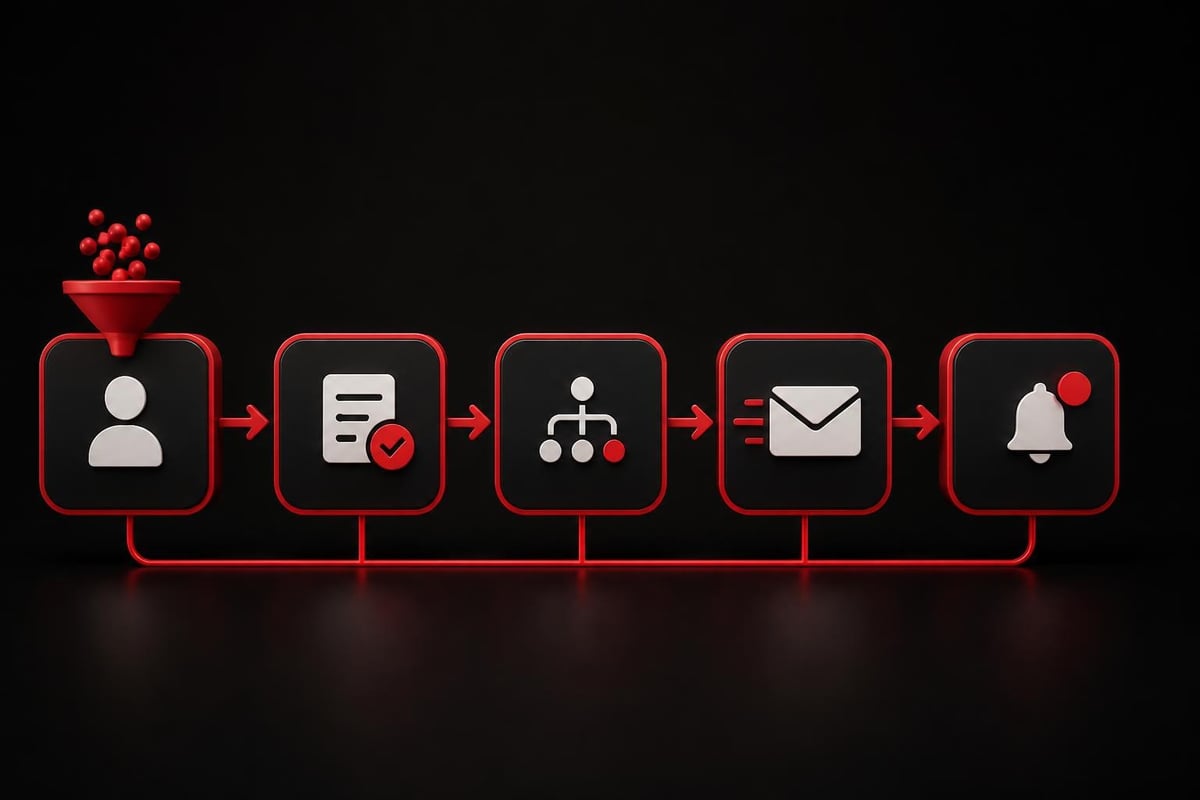
Automation is a tool, not a strategy. It’s useful for repetitive tasks-sending follow-up emails, updating CRM records, routing leads, scheduling reminders. It’s dangerous when applied to decisions that require judgement, context, or creativity.
The best marketing tips around automation focus on freeing time for higher-value work. Automate data entry so sales teams can focus on conversations. Automate lead scoring so marketing knows where to prioritise attention. Automate reporting so leadership sees current performance without manual spreadsheets.
But don’t automate blindly. Map the process first. Understand where automation adds value and where it introduces risk. Retain human oversight where nuance matters. For more on how to approach this balance, exploring RPA and AI workflows shows how automation can accelerate execution without removing judgement.
Tasks Worth Automating
- Lead capture and CRM entry
- Follow-up email sequences based on behaviour
- Lead assignment and routing
- Task and reminder creation
- Report generation and distribution
- Data synchronisation between platforms
Tasks That Still Need Humans
- Strategic decisions and budget allocation
- Creative development and messaging
- Complex customer conversations
- Exception handling and edge cases
- Relationship building and negotiation
Use Evidence to Guide Investment
The most practical marketing tips are based on evidence, not opinion or trends. Track what drives enquiries and revenue. Analyse which channels, messages, offers, and touchpoints create the best commercial outcomes. Then invest more in what works and stop funding what doesn’t.
This sounds obvious, but most businesses can’t do it because their data is fragmented. They know campaign cost but not campaign revenue. They track website visits but not which visits convert to customers. They measure email open rates but not email-driven sales.
Connected systems fix this. When advertising, CRM, sales, and analytics share data, you can calculate return on investment for every channel, campaign, and tactic. You can compare cost per acquisition across sources. You can see which customer segments are most profitable and adjust targeting accordingly.
According to insights from Harvard Business Review on growth and segmentation, businesses that base decisions on customer data and segment-specific performance consistently outperform those relying on intuition or industry averages.
Align Marketing and Sales as One System
Marketing generates demand. Sales converts it. When these functions operate independently, prospects fall through gaps, follow-up is inconsistent, and neither team knows what the other is doing. The result is wasted budget and lost revenue.
Treat marketing and sales as one connected system. Share data, align on definitions (what is a qualified lead?), and create feedback loops so each function improves the other. Marketing learns which leads convert so targeting improves. Sales understands prospect context so conversations are more relevant.
How to Connect Marketing and Sales
| Area | What to Align | How Systems Help |
|---|---|---|
| Lead definition | Agree on what “qualified” means | CRM scoring based on behaviour and fit |
| Handover process | Define when and how leads transfer | Automated routing and notification |
| Follow-up speed | Set response-time expectations | Task automation and alerts |
| Feedback loop | Share what converts and what doesn’t | Closed-loop reporting in CRM |
This alignment requires process design, not just good intentions. Define the workflow, connect the tools, and measure compliance. More on how to approach this is covered in integrated marketing and campaign systems.
Focus on Search With Intent, Not Just Rankings
Search remains one of the most valuable marketing channels because it captures existing demand. People searching for what you offer are further along the journey than people scrolling social feeds. But search has changed. Rankings alone don’t drive revenue. You need visibility where your prospects are looking, whether that’s traditional search, AI-generated answers, or vertical platforms.
Modern search strategy spans SEO, paid search, and answer engine optimisation. It focuses on customer intent and connects search activity to qualified enquiries and revenue. For practical guidance, Google’s SEO Starter Guide and Search Essentials remain the authoritative source on core practices.
What Search Strategy Should Include in 2026
- Traditional SEO: Content, technical health, and links based on customer intent
- Paid search: Campaigns optimised for revenue, not just clicks
- Answer engines: Structured content designed for AI summarisation and citation
- Local and vertical search: Visibility where your specific audience searches
- Tracking and attribution: Connecting search activity to enquiries, sales, and profit
Search works best when integrated with CRM and sales systems so you can measure which keywords, pages, and ad groups drive actual customers-not just traffic.

Build Infrastructure That Supports Growth
Marketing infrastructure is boring until it breaks. Hosting, domains, email deliverability, CRM configuration, automation platforms, analytics setup-these are the foundations that determine whether your marketing can scale reliably or collapses under load.
Most businesses under-invest here. They focus budget on campaigns and content while running marketing on fragile, disconnected infrastructure. When traffic increases, the website slows. When lead volume grows, the CRM can’t handle routing. When automation fails, nobody notices until prospects stop receiving follow-up.
Reliable marketing infrastructure isn’t glamorous, but it’s what separates businesses that scale from those that stall. It includes website hosting and performance, email sender reputation and deliverability, CRM configuration and data hygiene, automation platform setup and monitoring, and ongoing system management and support.
Invest in infrastructure early. Design it to handle growth. Monitor it continuously. Fix problems before they affect customers.
Avoid Trends, Follow Evidence
Marketing tips often chase trends: the newest platform, the latest tactic, the technology everyone is talking about. Established businesses don’t have time for experiments that don’t create value. Follow evidence, not hype.
This doesn’t mean ignoring innovation. It means testing thoughtfully, measuring rigorously, and scaling only what works. If a new platform offers access to your target audience, test it with a small budget and clear success criteria. If it delivers results, expand. If it doesn’t, move on.
Social media provides a useful example. According to Pew Research data on platform usage, demographics vary significantly by platform. Building a presence everywhere is wasteful. Build where your prospects are, and only if you can measure whether that presence drives commercial outcomes.
Questions to Ask Before Chasing Trends
- Does this reach our target audience better than existing channels?
- Can we measure its impact on enquiries, sales, or revenue?
- Do we have the capability to execute it well?
- What existing activity should we reduce to fund this test?
- What specific outcome will tell us whether to continue or stop?
Evidence beats enthusiasm. Test small, measure everything, scale what works.
Maintain Consistency Across Every Touchpoint
Prospects encounter your business across multiple channels: search, advertising, website, email, social, sales calls, proposals, invoices, support. Inconsistency at any point undermines trust and creates friction.
Consistency means more than visual branding. It’s tone, messaging, promises, processes, and experience. If your advertising promises fast response but enquiries sit unanswered for days, consistency is broken. If your website says one thing and your sales team says another, trust erodes.
To maintain consistency, document messaging, create templates for common touchpoints, define processes and service standards, train teams on brand and customer experience, and audit touchpoints regularly. The Content Marketing Institute’s resources on content operations provide useful templates and checklists for improving content quality and governance.
Consistency compounds. Every aligned touchpoint reinforces the previous one, building confidence and making conversion more likely.
Prioritise by Impact, Not Ease
When improving marketing systems, the temptation is to tackle easy wins first. Update the website. Refresh some content. Launch a new campaign. These feel productive, but they often deliver minimal commercial impact.
Instead, prioritise by what will most affect revenue and profit. That might mean fixing CRM data hygiene so sales can trust the pipeline. It might mean connecting advertising to closed sales so budget can be reallocated. It might mean automating lead routing so response time improves.
These projects are harder. They require cross-functional collaboration, system changes, and process redesign. But they create compounding value because they improve the foundation-not just the surface.
How to Prioritise Improvement Projects
- Identify the constraint: What’s limiting growth right now?
- Estimate commercial impact: What would fixing this be worth in revenue or profit?
- Assess feasibility: Do we have the capability and budget to execute this?
- Sequence logically: What needs to be fixed before other improvements can work?
- Measure results: How will we know this delivered the expected value?
Do fewer things. Do them well. Focus on impact.
Treat Data as a Strategic Asset
Data isn’t just reporting. It’s the raw material for better decisions. But most businesses collect data without using it, or use it inconsistently because it’s fragmented across platforms.
Treat data as a strategic asset. Define what you need to measure. Ensure systems capture it reliably. Centralise it so analysis is possible. Use it to guide every significant decision: budget allocation, targeting, messaging, hiring, and investment.
This requires discipline. Clean data regularly. Audit accuracy. Train teams on what data matters and how to use it. Build dashboards that surface insights, not just numbers. For businesses managing complex data across multiple platforms, exploring custom data visualisation can turn fragmented information into actionable intelligence.
Good data creates competitive advantage. Poor data creates expensive mistakes.
Marketing that drives revenue isn’t about doing more-it’s about connecting what you do so it compounds. Audit before you prescribe, measure outcomes instead of activity, and build systems that turn effort into measurable growth. If your marketing operates in silos or you’re uncertain whether it’s creating value, touchpoint.systems audits, designs, builds, and manages integrated growth systems that connect every platform and process into one measurable system.