
The title “marketing professional” has become almost meaningless through overuse. It now describes everyone from social media coordinators to chief marketing officers, from campaign managers to data analysts. What the role actually requires, though, has narrowed and sharpened considerably. A capable marketing professional in 2026 needs to understand integrated systems, speak fluent commercial language, and prioritise measurable outcomes over creative vanity projects. Those who can’t connect marketing activity to revenue, profit and customer lifetime value are being rapidly replaced by those who can.
What a Marketing Professional Actually Does Now
The job has shifted from campaign production to system orchestration. A marketing professional today operates across platforms, channels, customer touchpoints and business functions. They don’t just run advertisements or write content. They ensure CRM systems capture and route leads correctly, confirm automation workflows trigger at the right moments, verify attribution models reflect reality, and connect search behaviour to qualified enquiries.
Core responsibilities now include:
- Designing customer journeys that span multiple platforms and hand-off points
- Maintaining data integrity across CRM, advertising, analytics and sales systems
- Measuring and reporting on acquisition cost, conversion rates and revenue contribution
- Coordinating marketing infrastructure, automation platforms and lead-handling processes
- Managing the integration between marketing technology and commercial outcomes
The American Marketing Association’s 2026 career report confirms this shift, showing that roles emphasising systems thinking, data literacy and cross-functional integration are growing while purely creative or single-channel positions are consolidating or disappearing.
A marketing professional who can’t explain how their CRM integrates with their advertising platforms, or who treats analytics as someone else’s problem, is carrying significant career risk.

The Technical Competence Problem
Most marketing professionals still lack basic technical literacy. They can operate individual platforms but don’t understand how those platforms connect, what happens to data at integration points, or why certain workflows fail under load. This ignorance creates expensive gaps between marketing activity and commercial outcomes.
Systems vs. Campaigns
| Campaign Approach | Systems Approach |
|---|---|
| One-off executions | Connected infrastructure |
| Channel isolation | Cross-platform integration |
| Activity metrics | Revenue attribution |
| Campaign-specific tech | Permanent systems |
| Manual handovers | Automated workflows |
The difference matters commercially. Campaign-focused marketing professionals optimise individual tactics. Systems-focused professionals optimise the entire customer acquisition and retention process. The former creates short-term spikes. The latter builds compounding growth capacity.
Marketing stack interoperability has become a foundational competence, not an advanced specialisation. A marketing professional who can’t diagnose why leads aren’t flowing from advertising platforms into CRM, or why email automation stops triggering after a form submission, is operating at a disadvantage.
Commercial Literacy Is Not Optional
Marketing professionals who can’t read a P&L statement, calculate customer acquisition cost, or explain how marketing contributes to gross profit are increasingly unemployable. The discipline has professionalised, and commercial fluency is table stakes.
This means understanding:
- How revenue attribution actually works across multiple touchpoints
- What contribution margin means and why it matters more than revenue alone
- How to calculate payback period for customer acquisition investment
- The difference between marketing-qualified and sales-qualified leads
- Why lifetime value determines how much you can afford to spend on acquisition
Harvard Business Review recently analysed how AI is reshaping marketing strategy on two fronts: consumer behaviour and internal decision-making. Marketing professionals who lack commercial grounding are particularly vulnerable because they can’t evaluate AI recommendations against business logic. They accept algorithmic suggestions without assessing commercial viability.
A capable marketing professional questions the numbers. They ask why conversion rates dropped after a platform update, investigate whether attribution models are double-counting revenue, and challenge budget allocation that prioritises volume over profitability.
The AI Literacy Requirement
Ignoring AI won’t protect anyone’s job. The marketing professionals who survive the current transition are those who understand what AI does well, what it does poorly, and where human judgement remains essential.
AI excels at:
- Pattern recognition across large datasets
- Content production at scale
- Predictive modelling for customer behaviour
- Optimising bidding and budget allocation
- Personalisation based on historical interaction data
AI struggles with:
- Strategic positioning and market differentiation
- Understanding unstated customer needs and motivations
- Recognising when data patterns reflect past mistakes rather than future opportunities
- Navigating ambiguous situations without clear precedent
- Balancing short-term optimisation against long-term brand value
The Content Marketing Institute’s 2026 trends analysis emphasises that marketing professionals need to become AI-literate collaborators, not AI operators. The skill is knowing when to trust the algorithm, when to override it, and when to redesign the system feeding it data.

Search Behaviour and Intent Understanding
Search remains the clearest signal of commercial intent, yet many marketing professionals still treat it as a technical SEO problem rather than a strategic capability. Understanding how prospects search, what queries indicate genuine buying intent, and how to connect search activity to revenue is core work.
Think with Google’s analysis of 2025 search trends shows that video and answer-based queries now dominate commercial research. Marketing professionals who only optimise for traditional keyword rankings are missing the shift to answer engines and AI-mediated search results.
This changes how marketing systems need to operate:
- Content must answer specific questions, not just target keywords
- Structured data becomes essential for AI comprehension
- Video and rich media are no longer optional
- Search and conversion optimisation must connect through the entire customer journey
The strategic approach to SEO in 2026 requires marketing professionals to think beyond rankings and focus on qualified traffic that converts to enquiries and customers. Activity metrics like impressions and clicks matter less than attribution to revenue.
Skills That Actually Advance Careers
The marketing professional who builds durable career value focuses on competencies that compound rather than commoditise. Technical platform skills depreciate quickly. Strategic capabilities appreciate.
High-Value Competencies
Systems Architecture: Understanding how marketing technology connects across platforms, where data flows break, and how to design integrated infrastructure that supports growth rather than creating technical debt.
Commercial Analysis: Calculating unit economics, modelling customer lifetime value, attributing revenue across touchpoints, and presenting marketing performance in financial terms that boards and investors understand.
Process Design: Mapping customer journeys, identifying friction points, optimising handovers between marketing and sales, and automating repetitive workflows without losing necessary human oversight.
Evidence-Based Decision Making: Designing experiments that isolate variables, interpreting results without confirmation bias, and building institutional knowledge from what actually worked rather than what should have worked.
The AMA’s 2025 marketing skills report confirms that these capabilities are becoming hiring requirements, not differentiators. Marketing professionals who invest in mastering them move into leadership roles. Those who focus on execution skills alone plateau.
The Infrastructure Foundation
Marketing can’t operate reliably without proper infrastructure. Yet many marketing professionals still treat hosting, domains, email deliverability, CRM configuration and system integration as someone else’s responsibility. This creates dependency and limits what they can achieve.
Understanding marketing infrastructure as a foundational system rather than a technical afterthought changes what becomes possible. A marketing professional who controls infrastructure can implement changes quickly, test new approaches without external dependencies, and ensure customer data flows reliably from first contact through to sale and retention.
The technical components include:
- Website hosting that supports performance and security requirements
- Email infrastructure configured for deliverability and reputation management
- CRM systems integrated with advertising, analytics and sales platforms
- Automation platforms that trigger workflows based on customer behaviour
- Analytics and attribution systems that connect activity to commercial outcomes
Marketing professionals who lack infrastructure competence remain dependent on IT departments, agencies or vendors. Those who understand it gain operational independence and execution speed.
Measuring What Matters
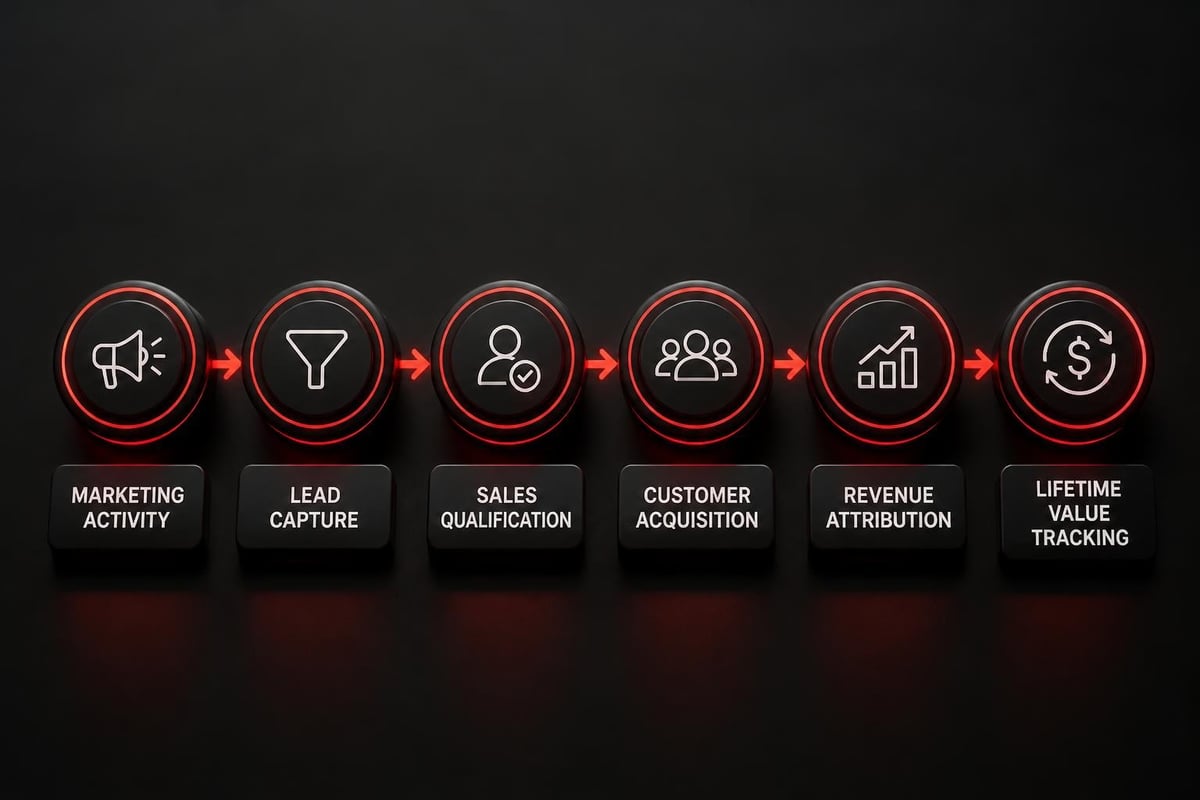
Activity metrics are useless theatre. A competent marketing professional measures what connects to commercial outcomes: qualified enquiries, conversion rates at each journey stage, customer acquisition cost, payback period, and lifetime value.
This requires:
- Attribution systems that track customer journeys across multiple touchpoints
- CRM integration that connects marketing activity to sales outcomes
- Revenue reporting that shows contribution by channel, campaign and customer cohort
- Cost allocation that captures fully loaded acquisition costs
- Regular audits that verify data accuracy and identify where tracking breaks
Many marketing systems report inflated or duplicate conversions because attribution models count the same customer multiple times. Deloitte’s research on early-adopter marketing advantages shows that organisations with clean data and accurate attribution significantly outperform competitors who rely on platform-reported metrics.
A marketing professional who accepts platform-reported conversions without verification is either naive or dishonest. Both are career-limiting positions.
Organisational Reality and Politics
Marketing professionals operate in political environments where budgets compete, credit gets claimed selectively, and blame flows downhill. Technical competence and commercial literacy aren’t sufficient. You also need to navigate organisational reality without becoming cynical or ineffective.
Practical survival strategies:
- Document decisions, recommendations and outcomes in writing
- Build alliances with sales, finance and product teams early
- Present marketing performance in terms that matter to executives (revenue, profit, efficiency)
- Under-promise and over-deliver rather than the reverse
- Protect your systems and data access
- Maintain external options so you’re never trapped by dependence
The marketing professionals who advance are those who deliver measurable results, communicate clearly in commercial language, and build cross-functional relationships based on mutual benefit rather than functional rivalry.
What Comes Next
The profession is splitting. On one side, marketing professionals who understand systems, speak commercial language, and deliver measurable outcomes. On the other, those who produce activity without accountability and defend their value by claiming marketing can’t be measured.
The latter group is disappearing. Not slowly. Quickly.
The marketing professionals who build careers that last focus on:
- Connected systems rather than isolated campaigns
- Revenue attribution rather than activity metrics
- Commercial outcomes rather than creative awards
- Evidence rather than assumptions
- Infrastructure ownership rather than vendor dependence
The capability requirements will keep rising. Marketing professionals who commit to continuous learning, stay technically literate, maintain commercial fluency, and build integrated systems will find opportunities. Those who resist these shifts will find their options narrowing rapidly.
The profession rewards competence and punishes complacency. That’s uncomfortable for many people currently holding marketing roles. It’s also clarifying. If you’re not prepared to master systems thinking, commercial analysis, technical integration and evidence-based decision making, you’re choosing a diminishing career path.
If you are prepared to build those capabilities, the opportunities are substantial. Established businesses need marketing professionals who can replace disconnected campaigns with integrated growth systems that connect customer acquisition, conversion optimisation, and retention into one measurable, scalable process.
The choice has never been clearer. The job title hasn’t changed. The job has.
A capable marketing professional in 2026 understands that campaigns are temporary but systems compound. If your current marketing infrastructure operates as disconnected tools rather than integrated systems, or if you’re measuring activity instead of commercial outcomes, touchpoint.systems can audit what you have, identify where value is being lost, and build the connected infrastructure that turns marketing into a measurable growth system.