
More marketing activity doesn’t necessarily mean more commercial visibility. A marketing systems audit starts where dashboard summaries stop: with the connections between tools, customer data and the sales pipeline.
It’s frustrating when campaign activity is easy to report but its contribution to qualified prospects and revenue is hard to trace. Split records, manual handovers and inconsistent definitions can make the problem look like a channel issue, when the real fault sits between systems. Adding another platform rarely fixes a broken connection.
This article explains what to examine before deciding what to change. Trace how prospect information moves from first interaction through CRM, automation and sales, then check whether reporting preserves enough context to assess its commercial contribution. You’ll see how to identify workflow friction, data gaps and weak measurement, then build a clear view of what works, what needs improvement and what warrants further investigation. Audit first. Prescribe second.
Key Takeaways
- A marketing systems audit maps how platforms, customer data and workflows connect across the customer journey.
- Trace each key measure back to its source record to distinguish reported activity from evidence of qualified progression.
- Assess findings against customer impact, operational friction, data quality and technical feasibility before prioritising changes.
- An audit may point to better integration, workflows or reporting. Replacing a platform is only one possible response.
What a marketing systems audit reveals about disconnected growth
A campaign can generate enquiries while the business still can’t explain which prospects progressed, how quickly sales followed up or where reporting stopped matching the pipeline. The activity is visible. The connection between activity and commercial evidence isn’t.
A marketing systems audit is a structured review of the platforms, customer data, workflows and performance evidence that support marketing and sales. It traces how information moves between systems and teams, then checks whether that flow supports a reliable view of the customer journey and commercial contribution.
The point is diagnosis, not a pretext for replacing software. An audit should identify what works, what breaks and what still needs investigation before anyone prescribes a fix.
How is a marketing systems audit different from a general marketing audit?
A general marketing review may assess goals, channels, messaging and campaign performance. A campaign report summarises activity over a period. A marketing plan sets direction. A systems audit examines the operating connections underneath: how a prospect’s enquiry enters the business, how it is recorded, who receives it and whether later outcomes remain linked to the original interaction.
For example, a search campaign may report form submissions while the CRM contains duplicate records or sales updates are entered elsewhere. The enquiry count may be accurate, yet the path from enquiry to qualified opportunity remains difficult to verify. The Marketing Metric Audit Protocol reflects the value of connecting intermediate marketing measures to business cash-flow drivers. The audit tests whether those connections exist in practice, not just in a report.
Findings inform decisions; they don’t dictate a rebuild. The right response may be to retain a platform, repair a handover, improve reporting or investigate a data gap. Technology is a tool, not a trophy.
When might an established service business need one?
Look for recurring operational symptoms rather than waiting for a dramatic failure. Examples include:
- Duplicate prospect records across marketing and sales platforms.
- Manual data entry to move enquiry details between systems.
- Pipeline reports that use inconsistent definitions or disagree with sales records.
- Follow-up handovers that depend on staff noticing, copying or forwarding information.
These patterns don’t automatically mean revenue is being lost. They do make it harder to see whether prospects receive consistent follow-up, where delays occur and which records support a reported result. An audit maps the actual process, including exceptions and workarounds, then separates verified problems from assumptions.
In short: a marketing systems audit examines how platforms, data and workflows connect, and whether the resulting evidence supports sound commercial decisions. Its output is a grounded view of what to retain, improve or investigate further, not a change list written before the facts are in.
Which systems and customer-data flows should a marketing systems audit examine?
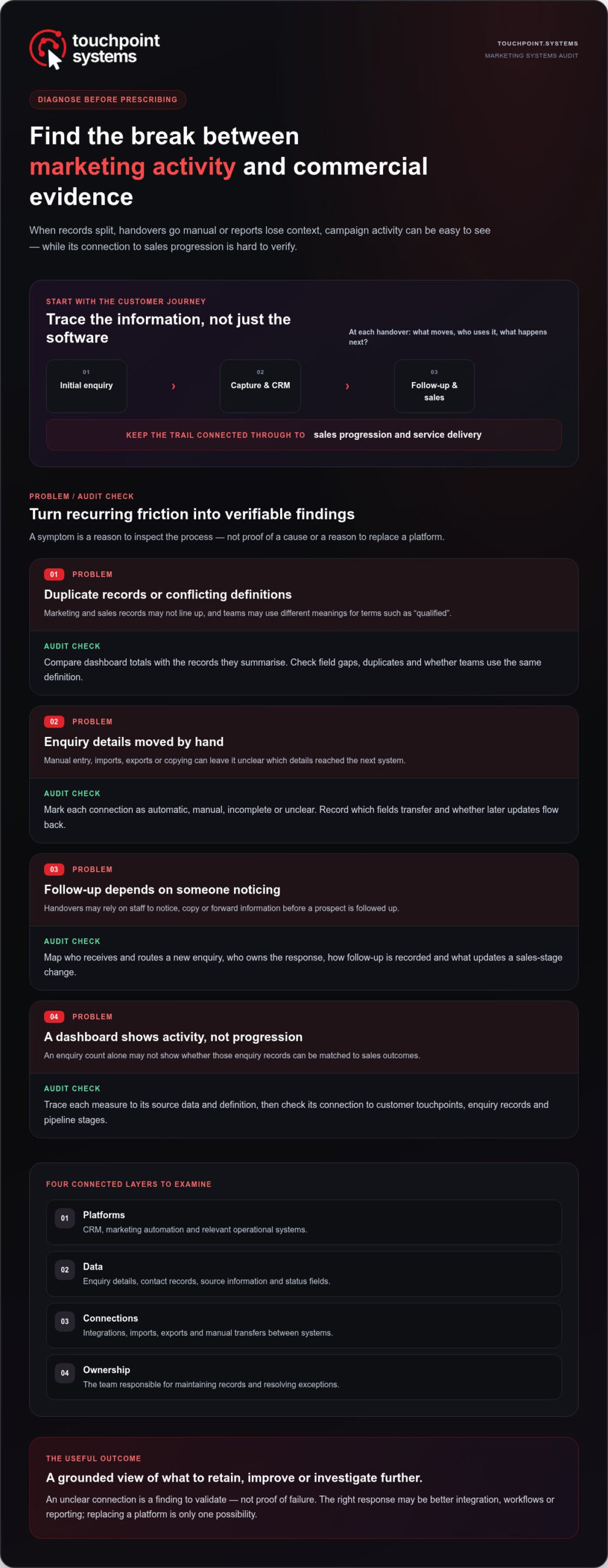
Start with the customer journey, not the software catalogue. Trace what happens from an initial enquiry through capture, CRM, follow-up, sales progression and service delivery. At each handover, record what information moves, who uses it and what the next team needs to act.
A marketing systems audit should examine four connected layers: platforms, data, workflows and reporting. Mapping these layers shows whether systems support a continuous customer journey or leave staff to bridge the gaps manually. For a practical checklist of what to assess across the stack, see this marketing technology audit.
How should an audit map platforms and integrations?
Build an inventory that gives each platform an operational context. Record its purpose, the customer or prospect data it holds, who owns it and which other processes depend on it. Then trace where records originate and which systems create, update or use them. This reveals overlaps and dependencies that a list of software names misses.
- Platforms: CRM, marketing automation and relevant operational systems.
- Data: enquiry details, contact records, source information and status fields.
- Connections: integrations, imports, exports and manual transfers.
- Ownership: the team responsible for maintaining records and resolving exceptions.
Mark each handover as automatic, manual, incomplete or unclear. For example, if a staff member copies a prospect’s enquiry details into the CRM, note which fields are transferred and whether later updates flow back to the original platform. Treat an unclear connection as a finding to validate, not proof that the integration has failed.
What can workflows and reporting reveal?
Follow the operational sequence: who receives a new enquiry, how it’s routed, who owns the response, how follow-up is recorded and what updates a sales-stage change. The Harvard Business School Online’s marketing audit framework offers a structured way to assess digital marketing; a systems review also traces how those activities connect to internal records and handovers.
Then inspect the reporting behind the dashboards. For each measure, identify its source data, definition and connection to customer touchpoints, enquiry records and pipeline stages. A dashboard may show enquiry volume, for instance, but if enquiry records can’t be matched to sales outcomes, that figure alone won’t explain progression.
- Check whether teams use the same meaning for terms such as “qualified”.
- Compare dashboard totals with the records they’re meant to summarise.
- Note missing fields, duplicate records and updates that depend on manual entry.
Map the actual process, including workarounds. That gives leaders a firmer basis for deciding whether the issue sits in a platform, a data handover, workflow ownership or reporting logic. For established service businesses assessing system connections, Audit and Feasibility work can evaluate findings before implementation decisions.
How can an audit separate marketing activity from commercial evidence?
A click records an interaction. An enquiry records a response. Neither, by itself, shows that a prospect was qualified, entered the sales pipeline or progressed towards a commercial outcome. The distinction matters: activity describes what happened at a touchpoint; commercial evidence shows what can be verified in the customer and pipeline records.
Activity alone doesn’t prove pipeline contribution. To assess contribution, trace the measure to its source, confirm how it’s defined and check whether it connects to relevant prospect and sales records. A marketing systems audit should make the strength of that connection visible, not disguise a tracking gap with a confident chart.
What makes a marketing measure decision-useful?
For each measure, record its source, definition, owner and update process. Then follow the data into the CRM or sales record, where available. If the connection is incomplete, say so. A conclusion based on a partial record is still partial, however tidy the dashboard looks.
The table shows how to assess common measures. Confidence is a practical judgement, not a statistical score: it depends on whether the required records can be matched and verified.
| Measure | Source record | Connection to check | Confidence in commercial interpretation |
|---|---|---|---|
| Clicks | Search or campaign reporting | Can the interaction be linked to a later enquiry? | Low for pipeline contribution on its own |
| Enquiries | Form, phone or other enquiry record | Does the record connect to a unique prospect and CRM entry? | Moderate if records match; lower if duplicated or incomplete |
| Qualified prospects | CRM qualification fields and sales notes | Is “qualified” consistently defined and recorded? | Higher when definitions and records are consistent |
| Pipeline progression | CRM sales-stage history | Can progression be linked to the prospect and relevant touchpoints? | Higher when the links and updates are verifiable |
How can a systems issue be distinguished from a campaign issue?
Check the mechanics before judging the channel. Confirm that enquiry capture works, routing reaches the right owner, follow-up is recorded and sales-stage updates appear in the system used for reporting. Compare those operational records with campaign observations. A weak pipeline result may reflect channel performance, but missing capture or inconsistent follow-up can also limit what the records show.
Keep findings in three categories:
- Observed fact: the enquiry appears in campaign reporting but has no matching CRM record.
- Possible cause: a capture or synchronisation step may be incomplete.
- Unverified hypothesis: the missing record affected follow-up or pipeline progression.
Validate each explanation before treating it as the cause. Duplicate, incomplete or disconnected records weaken attribution confidence; they don’t establish why a result occurred. The useful outcome is a clear account of what the evidence supports, where confidence falls away and what needs checking next.
How should leaders interpret and prioritise marketing systems audit findings?
A finding is not yet a recommendation. First establish what the evidence shows, then determine its operational effect, dependencies and practical feasibility. This prevents a visible annoyance from becoming a project before anyone has checked its cause.
Use a consistent sequence:
- Document the evidence. Record what was observed, where it came from and which customer-journey stage it affects.
- Validate the impact. Check how often the issue occurs and what it means for customer experience, staff effort or the reliability of reporting.
- Assess dependencies. Identify the platforms, data and workflows that rely on the affected process.
- Prioritise and assign ownership. Agree what needs action, what needs more investigation and who is accountable for the next step.
Keep operational impact separate from commercial significance. A repeated manual handover may clearly consume staff time, while its effect on revenue or profit may remain unknown. Estimating that effect requires relevant business data, such as reliable records of the affected enquiries, sales progression and staff effort. Without that evidence, label the commercial impact as unquantified rather than presenting a guess as a business case.
How can findings be prioritised without false precision?
A single score can make uncertain evidence look exact. Use clear categories instead, such as address now, investigate further or monitor, and state the reason for each classification. Assess severity, frequency, affected journey stages and technical dependencies separately. A frequent issue affecting enquiry follow-up may deserve attention, but a solution that depends on several integrations may require feasibility work first.
Mark assumptions and unresolved questions explicitly. For example, distinguish “records are missing at this handover” from “the handover caused a prospect to receive no follow-up”. The first may be observed; the second needs validation. That distinction helps leaders prioritise without overstating what the audit proves.
What should a useful audit summary make clear?
Make every finding usable by the person responsible for acting on it. Summarise the evidence, affected journey stage, operational or customer impact, accountable owner, dependencies and outstanding feasibility questions. Separate contained process changes from work that depends on architecture, integration or data quality. State what additional business information is needed before estimating commercial significance.
- Finding: the issue, stated in plain language.
- Evidence: the records or observations that support it.
- Priority and owner: the reason for its category and who takes the next step.
- Open questions: assumptions, dependencies and information still needed.
This gives decision-makers a sound starting point for a practical marketing systems roadmap: a sequence of evidence-based decisions, not a shopping list of new tools. Audit and feasibility work can help established service businesses assess findings before choosing an implementation path.
What should happen after a marketing systems audit?
An audit should narrow the decision, not create an automatic mandate to buy or replace technology. Its findings might point to a workflow adjustment, a clearer reporting definition, a repaired integration or a need for further investigation. The next step is feasibility: test whether a proposed change is technically viable and commercially relevant before committing to implementation.
That test matters because a change can be technically possible and still be the wrong use of effort. Tie each proposal to an observed issue and a business priority, such as reducing manual handling, improving customer handovers or making sales reporting more reliable. If the evidence is incomplete, resolve that gap before treating an assumed benefit as established.
How does feasibility help avoid premature implementation?
Feasibility examines existing systems and dependencies before recommending architectural changes. It considers whether current platforms can support the required workflow, what data needs to move between them and what other processes depend on those connections. The purpose is to assess technical viability alongside commercial relevance, not to make complexity sound like progress.
A contained process fix may address a handover without changing the underlying platform. An integration change may be needed where records don’t pass reliably between systems. A wider redesign may warrant investigation if dependencies make targeted changes impractical. Each option should follow from the evidence and account for operational impact, data quality and implementation requirements. Replacement is one possible response, not the default.
When is a connected growth-systems approach relevant?
This approach is relevant to established service businesses whose tools, workflows or performance reporting have developed in separate pieces. CRM, automation, search, conversion and reporting affect different parts of the customer journey, but they need to work as a coherent operating system. A search interaction, for example, is more useful for decision-making when the resulting enquiry can be understood alongside its CRM record and later sales progress.
touchpoint.systems audits, designs, builds and manages connected growth systems for established service businesses. This work can connect CRM, workflow automation, search, conversion and reporting where findings show those connections are needed. The aim is a grounded implementation decision, not technology for its own sake or a promise of commercial outcomes.
If you’re weighing up what to retain, improve or investigate, explore an audit and feasibility review. The useful result is a clearer next decision, even when that decision is to leave a working system alone.
Make the next system decision with evidence
The value of a marketing systems audit isn’t measured by how many recommendations it produces. It’s measured by whether leaders can make a clearer decision about what to change, what to leave alone and what evidence is still missing.
Before implementation, set a practical test for the proposed change. Name who owns it, what part of the process it affects and what information will show whether it works as intended. That gives the change a clear boundary. It also helps distinguish a functioning improvement from a new layer of technology that merely looks busy.
Not every finding needs immediate action. Some need better records. Others need a technical assessment or a decision about competing business priorities. Keeping those paths distinct helps teams move deliberately, without treating every system problem as a reason to rebuild.
If you’re ready to assess the options for your business, map out your next systems decision. A measured next step is still progress, and it gives your team a stronger basis for what comes after.
Frequently Asked Questions
How long does a marketing systems audit take?
There’s no standard duration for a marketing systems audit. Agree on the decision the review needs to support, then allow time to examine evidence, resolve inconsistencies and validate findings with the people who use the systems. A review isn’t complete just because the documents have been collected. It’s complete when the evidence is clear enough to support a defensible next step, or to show what remains unknown.
Can a marketing systems audit be completed without replacing existing platforms?
Yes. The review can assess whether current platforms are configured and used in a way that supports the business’s needs. It can also document constraints, such as dependencies on existing processes or information that teams rely on. That gives decision-makers a practical basis for considering options without treating a platform change as the purpose of the exercise. Implementation choices come after the assessment, not before it.
Who should be involved in a marketing systems audit?
Include people who can explain how the systems are used and people authorised to make decisions about them. A marketing or sales operator can clarify day-to-day practice; a system owner can explain access and configuration; an executive can set the business question. Ask participants to distinguish what they’ve directly observed from what they assume. That makes it easier to validate findings without turning the review into a debate about preferred tools.
How often should a business conduct a marketing systems audit?
There’s no universal timetable. Rather than scheduling reviews as routine paperwork, consider whether the business’s systems or decision needs have changed enough to make earlier findings unreliable. Keep a record of previous findings and decisions, then check whether the assumptions behind them still hold. A focused reassessment may be more useful than repeating a broad review when only one part of the operating environment has changed.
Can a marketing systems audit show why enquiries are not reaching sales?
It can help narrow down where the issue may sit, but it can’t establish a cause from a headline enquiry count alone. For example, distinguish enquiries that sales reviewed and did not progress from records with no documented sales decision. The first may reflect qualification or business priorities; the second may point to incomplete records or an unresolved process question. Confirm the explanation with relevant records and staff before acting on it.
What information should a business prepare before a marketing systems audit?
Prepare a short brief describing the decision leaders need to make, the questions they want answered and any known limits on access to systems or records. Identify who can approve access and who can explain unfamiliar terminology or reporting definitions. There’s no need to make every document perfect first. A clear account of what the business is trying to understand helps keep the review focused and makes gaps in the available evidence easier to identify.