
Most agencies marketing looks identical. Vague positioning about “creativity”, “performance”, or “partnership”. Case studies that omit revenue. Promises disconnected from how businesses actually buy. The problem isn’t insufficient promotion-it’s that agencies market themselves the way they’ve always marketed themselves, ignoring evidence about what actually persuades established businesses to hire, retain, or fire them.
What Agencies Actually Sell Versus What Businesses Buy
The disconnect begins with product definition. Agencies describe what they do-media buying, creative development, strategy, content production. Businesses evaluate what they get-measurable impact on pipeline, revenue, customer acquisition cost, market share, or retention.
When agencies marketing emphasises outputs instead of outcomes, it selects for the wrong buyer. You attract procurement departments comparing line-item costs. You repel commercial decision-makers who need to know whether the investment creates more profit than it consumes.
The Language Gap
Agencies talk about campaigns. Businesses run customer journeys. Agencies optimise channels. Businesses optimise conversion across the entire funnel from awareness to repeat purchase. Agencies report impressions, clicks, engagement. Businesses measure qualified enquiries, sales pipeline velocity, customer lifetime value.

This isn’t semantic. Forrester research on B2B agency relationships confirms that dissatisfaction stems less from creative quality than from failure to demonstrate commercial impact. Established businesses don’t replace agencies because the ads weren’t clever. They replace them because the relationship didn’t visibly contribute to growth.
How Established Businesses Actually Select Agencies
New business processes reward agencies that already understand systems, data, and connected infrastructure. Here’s what actually influences selection:
- Demonstrated understanding of the prospect’s current state before prescribing solutions
- Evidence of commercial outcomes from similar engagements, with specifics
- Clear explanation of how work will be measured and connected to business results
- Credible integration plan with existing platforms, processes and internal teams
- Pricing tied to value rather than arbitrary retainers or FTE-based day rates
Notice what’s absent: agency awards, team bios, office locations, creative philosophy. These might reassure junior marketers. They don’t persuade business operators evaluating whether an investment will pay back.
The 4A’s guidance on pitching acknowledges this shift, recommending agencies lead with business context and measurable goals rather than speculative creative. Most agencies marketing still does the opposite.
Why Credentials Decks Fail
Standard agency credentials follow a tired pattern: founder story, team structure, client logos, case studies light on numbers, closing slide about “partnership”. This format optimised for a world where marketing was discretionary spend managed by marketing departments with minimal accountability.
That world is gone. Marketing budgets now compete with product development, technology investment, and hiring. Decisions involve finance, operations, and executives who evaluate marketing like any capital allocation-expected return, risk, time to payback.
| Traditional Agency Positioning | What Decision-Makers Actually Evaluate |
|---|---|
| “Award-winning creative team” | “Will this generate qualified pipeline?” |
| “Full-service capabilities” | “Do they connect to our existing systems?” |
| “Strategic partnership” | “How do we measure success and exit if it fails?” |
| “Proven process” | “What evidence proves the process works for businesses like ours?” |
Your agencies marketing needs to answer the right column before anyone cares about the left.
The Pitch Problem: Selling Theatre Instead of Systems
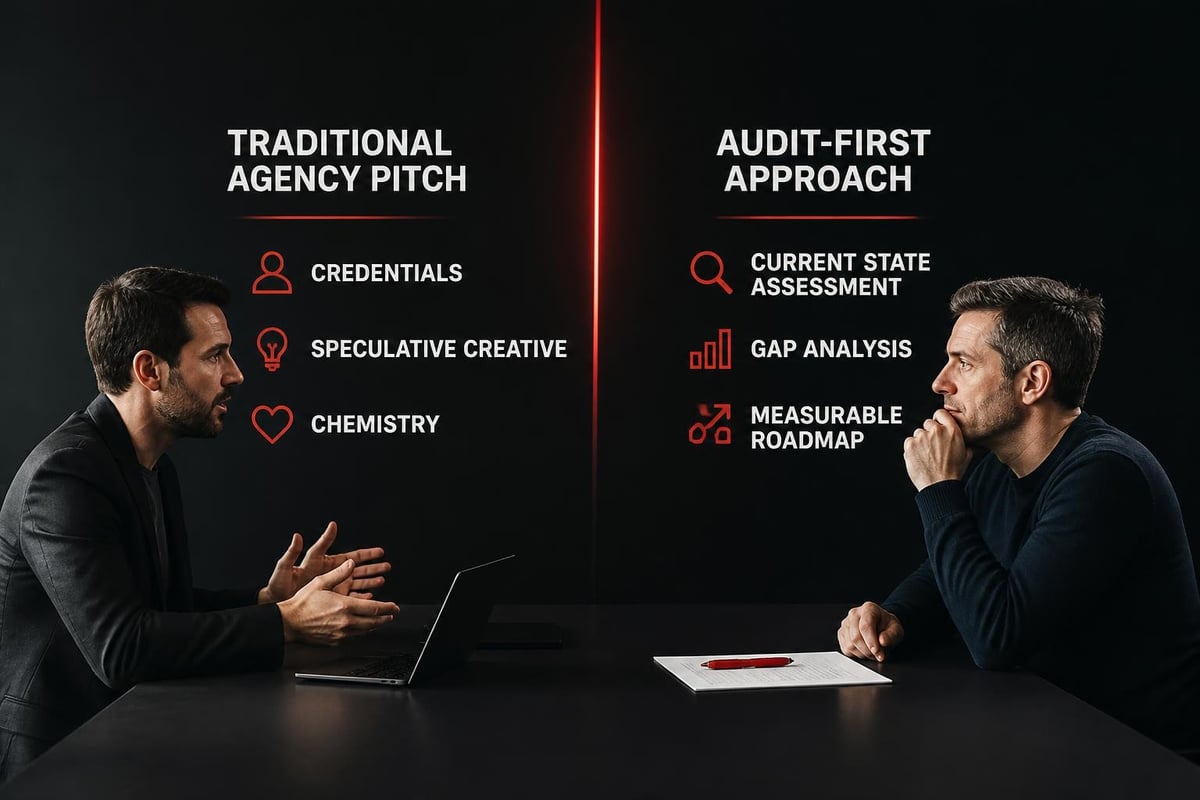
Agencies invest disproportionate effort in pitch theatre-presentations, speculative campaigns, chemistry meetings-while underinvesting in the audit and diagnostic work that would actually demonstrate competence.
A business evaluating agency partners wants to know: do you understand our current systems, customer journey, data infrastructure, and commercial model well enough to identify where marketing creates or destroys value?
Most pitches skip this entirely. Agencies present what they’d do without demonstrating they understand what’s already happening, what’s working, what’s broken, or how proposed activity connects to revenue.
The Audit-First Alternative
Agencies serious about agencies marketing that works start with objective assessment of marketing systems and processes. This approach:
- Earns credibility by revealing issues the prospect recognises but hasn’t articulated
- Differentiates immediately from agencies leading with solutions before diagnosis
- Creates commercial conversations about impact, not activity
- Establishes measurement frameworks before any campaign launches
- Identifies integration requirements with CRM, sales processes, and existing technology
When your new business process mirrors how you’d actually work with a customer-assess, diagnose, prescribe, measure-you attract businesses that value substance over spectacle.
Why Platform Agnosticism Matters More Than Specialisation
Agencies marketing around platform expertise-“HubSpot specialists”, “Meta partners”, “Salesforce certified”-optimise for vendor referrals, not customer outcomes. Established businesses don’t hire agencies to use specific platforms. They hire agencies to solve commercial problems, which usually require connecting multiple platforms into coherent systems.
The platform-agnostic positioning matters because:
- It signals you prioritise outcomes over tools-you’ll recommend what works, not what you’re certified to sell
- It demonstrates integration competence-you’ve connected different technologies before
- It reduces lock-in risk-businesses aren’t trapped if they need to change platforms
- It enables honest evaluation-you can objectively assess whether current infrastructure works or needs replacement
This doesn’t mean avoiding technical depth. It means your agencies marketing emphasises commercial problem-solving ability rather than vendor relationships.
Remuneration Models and the Death of the Retainer
The traditional monthly retainer is dying. Global brand owners are demanding changes to agency compensation, shifting toward outcome-based models, project fees, and performance-linked arrangements.
For agencies marketing themselves to established businesses, this creates opportunity. While traditional agencies resist outcome-based pricing (because they can’t demonstrate outcomes), agencies built around connected systems and measurable results can embrace it.
Pricing Models That Align With Value
Consider alternatives to “£8,000 per month for undefined marketing services”:
- Diagnostic and roadmap projects that identify specific opportunities before ongoing work
- Infrastructure and integration fees for building connected marketing systems that support multiple initiatives
- Performance-based components tied to pipeline volume, qualified enquiries, or revenue contribution
- Milestone pricing for implementation projects with defined deliverables and success criteria
The PwC analysis of agency model evolution recommends agencies standardise service offerings and pricing to reduce the bespoke nature of every engagement. This makes agencies marketing more effective-prospects understand what they’re buying and how to compare options.
What Clients Think Versus What Agencies Assume
Annual research into client-agency relationships reveals consistent themes that most agencies marketing ignores:
- Clients value proactive thinking and commercial awareness over creative awards
- Transparency around costs and value matters more than elaborate capabilities
- Speed and responsiveness outrank strategic sophistication in satisfaction surveys
- Integration with internal teams determines success more than agency talent alone
- Measurement and reporting clarity directly correlates with retention
None of these points suggest businesses want cheaper, faster, or less strategic work. They want agencies that behave like commercial partners rather than creative services vendors.
Your agencies marketing should demonstrate these behaviours before the contract starts. If your website, pitch process, and positioning don’t reflect commercial awareness, proactive thinking, transparency, integration competence, and measurement clarity, you’ve already signalled you won’t deliver them as a partner.
Content Marketing for Agencies: Proof Over Promises
Most agency content marketing fails the same way agency positioning fails-too much assertion, insufficient evidence. Blog posts about “the future of marketing”, “why brands need purpose”, or “maximising social ROI” signal nothing except the ability to generate content.
Useful content for agencies marketing to established businesses:
- Specific diagnostic frameworks they can apply to evaluate their current state
- Case studies with commercial detail-revenue impact, cost reduction, efficiency gains, with numbers
- Technical explanations of how platforms connect, what integration actually requires, where common failures occur
- Process documentation showing how work happens, who does what, how changes are managed
- Transparent methodology for measurement, attribution, and reporting
This content serves dual purposes. It attracts businesses searching for specific expertise. It pre-qualifies prospects-those who engage with substantive technical content are likelier to value technical competence.
Publishing Strategy That Builds Credibility
Rather than frequent shallow posts optimised for engagement metrics, consider:
- In-depth technical guides that demonstrate actual expertise
- Audit checklists and frameworks prospects can use independently
- Data analysis and research that reveals insights competitors haven’t published
- Infrastructure and integration documentation showing you’ve solved complex problems before
- Measurement and attribution methodologies explained with worked examples
This approach to agencies marketing and content strategy builds authority with business operators while filtering out prospects seeking cheap execution rather than commercial partnership.
The Systems Argument: Why Integration Beats Isolation
The strongest agencies marketing argument in 2026 isn’t about channel expertise or creative capability. It’s about systems thinking-the ability to connect marketing to sales, customer data, product usage, financial outcomes, and operational systems.
Established businesses don’t need better Facebook ads. They need marketing that:
- Flows qualified prospects to sales teams with complete context and appropriate timing
- Tracks customer journeys across multiple touchpoints and channels without losing attribution
- Connects campaign activity to pipeline, revenue, and customer lifetime value
- Enables intelligent segmentation based on behaviour, value, and commercial potential
- Supports retention and expansion through integrated customer communication
None of this happens through channel-specific tactics. It requires connecting platforms and processes into coherent growth systems.

Agencies marketing around systems integration rather than channel execution attract businesses ready to move beyond siloed campaigns. These engagements last longer, create more value, and resist commoditisation because the barrier to switching isn’t creative preference-it’s integrated infrastructure.
Technical Infrastructure as Competitive Advantage
Most agencies treat infrastructure as someone else’s problem. Websites, hosting, domains, email deliverability, marketing automation, CRM configuration, analytics implementation-delegated to clients, third-party vendors, or junior team members.
This creates fragility. Campaigns fail because landing pages load slowly. Attribution breaks because tracking wasn’t implemented properly. Leads vanish because CRM integration was configured incorrectly. Customer journeys fracture because nobody owns the connections between systems.
Agencies that build, own, and manage technical marketing infrastructure as core competency rather than afterthought gain competitive advantage:
- Campaigns launch faster without coordination delays across multiple vendors
- Measurement works reliably because tracking, attribution, and data flow are architected properly
- Customer experience improves when infrastructure supports consistent journeys rather than disconnected touchpoints
- Costs decrease when infrastructure scales efficiently rather than requiring manual intervention
Your agencies marketing should emphasise this if you actually do it. If you don’t, consider whether outsourcing infrastructure is costing you opportunities with businesses that need connected systems, not fragmented campaigns.
Differentiation Through Diagnostic Competence
Every agency claims strategic thinking. Few demonstrate diagnostic competence-the ability to assess a business’s current marketing systems, identify specific gaps and inefficiencies, quantify opportunity cost, and prescribe improvements with measurable impact.
Diagnostic competence requires:
- Frameworks for evaluating marketing maturity, systems integration, process efficiency, and data quality
- Technical knowledge across platforms, APIs, data architecture, and automation capabilities
- Commercial literacy to translate marketing activities into revenue, profit, and customer value
- Objective methodology that produces consistent, defensible assessments
- Communication skills to explain findings and recommendations to non-marketing executives
When agencies marketing leads with diagnostic capability instead of creative portfolio, it attracts businesses at inflection points-they know something’s wrong, they need objective assessment before committing to solutions, they’ll pay for clarity even before implementation.
This positioning also filters prospects. Businesses seeking cheap execution won’t engage diagnostic services. Businesses ready to invest in systematic improvement will.
Measurement, Attribution, and the Accountability Gap
The gap between what agencies report and what businesses need to know remains absurdly wide. Agencies provide campaign metrics-impressions, clicks, engagement, website visitors. Businesses need commercial insight-which campaigns generate qualified pipeline, what’s the cost per closed sale, how does customer acquisition cost trend over time, where is marketing investment creating profit.
Agencies marketing that addresses this gap directly wins:
- Build measurement frameworks before campaigns launch, connecting activity to commercial outcomes
- Implement proper attribution across the full customer journey, not just last-click
- Report in business language, translating marketing metrics into revenue and profit impact
- Create feedback loops where campaign performance informs targeting, messaging, and investment allocation
- Enable visibility for non-marketing executives who control budgets but don’t speak marketing
The barrier isn’t technical. Custom data visualisation and reporting that connects marketing data to commercial outcomes is achievable for any agency willing to invest in it. The barrier is cultural-agencies built around creativity, storytelling, and channel tactics resist the accountability that clear measurement creates.
If you embrace it, your agencies marketing can differentiate on substance rather than style.
Effective agencies marketing requires the same discipline effective agencies apply to customer work: audit before prescription, systems over silos, evidence over activity, measurement that connects to commercial outcomes. Most agencies skip this discipline in their own marketing, then wonder why they attract price-sensitive prospects rather than businesses ready to invest in growth. If you need help building connected marketing systems that replace siloed campaigns with measurable, integrated infrastructure-whether for your agency or your customers-that’s precisely what we do.