
Most established businesses treat marketing and services as separate functions. Marketing generates leads, services deliver value, and somewhere in between sits a disconnected handover process that leaks revenue, frustrates customers, and obscures what actually drives growth. This separation made sense when marketing meant brochures and Yellow Pages ads. In 2026, when every customer interaction generates data and every service touchpoint influences future revenue, the division creates expensive inefficiency. The solution isn’t better coordination between silos. It’s recognising that marketing and services form one connected system where customer acquisition, delivery, retention, and growth feed each other.
Why Marketing and Services Must Connect
The boundary between marketing and services exists on org charts, not in customer experience. A prospect researching your business doesn’t care whether website content, email sequences, sales conversations, onboarding processes, and ongoing service sit in different departments. They experience a continuous journey where each interaction either builds confidence or introduces friction.
Traditional approaches separate these functions by budget, team, and measurement. Marketing owns cost-per-lead and conversion rates. Services track delivery metrics and satisfaction scores. Revenue attribution becomes guesswork, investment decisions rely on incomplete data, and neither function sees the full commercial picture.
The commercial cost shows up in three places:
- Qualified prospects disappear during handover between marketing-generated interest and service onboarding
- Service delivery teams lack visibility into what marketing promised, creating expectation gaps
- Marketing optimises for volume without understanding which customer types generate profitable, retained revenue
Harvard Business Review research on linking sales and marketing demonstrates that businesses using digital customer hubs to connect these functions see measurably better outcomes than those maintaining separate systems. The advantage isn’t coordination. It’s unified data, consistent processes, and commercial accountability across the entire customer journey.

What Connected Marketing and Services Actually Means
Integration isn’t about technology alone. Buying a CRM doesn’t connect marketing and services if each function uses different fields, follows different processes, and measures different outcomes. Real connection requires shared data, aligned processes, and unified measurement focused on commercial results rather than departmental activity.
The Three Integration Layers
| Layer | What It Connects | Why It Matters |
|---|---|---|
| Data | Customer information, interaction history, purchase behaviour, service delivery details, support issues | Eliminates duplicate records, incomplete handovers, and decisions based on partial information |
| Process | Lead capture, qualification, sales, onboarding, service delivery, retention, upsell | Removes gaps where prospects and customers fall through cracks between functions |
| Measurement | Marketing spend, acquisition cost, customer lifetime value, service profitability, retention rate | Shows what actually drives revenue instead of which department hit its activity targets |
Connected marketing and services means a prospect’s initial website visit, subsequent email interactions, sales conversations, contract details, onboarding progress, service delivery history, support tickets, and renewal likelihood all exist in one accessible system. Marketing sees which campaigns generate profitable customers, not just leads. Service teams understand what was promised and which customer segments require more support. Leadership can measure true acquisition cost against actual customer value.
This requires platforms that share data reliably, processes that maintain consistency across functions, and teams that understand their role in the complete customer journey. The alternative is expensive software that creates new silos while claiming to solve the problem.
Building the Foundation: Audit Before Architecture
Most businesses already own platforms that could support connected marketing and services. The CRM contains customer data. Marketing automation handles email sequences. Project management tools track delivery. Analytics platforms measure website behaviour. The problem isn’t missing technology. It’s that these platforms don’t talk to each other, teams use them inconsistently, and nobody can answer basic questions about customer acquisition cost or lifetime value.
Starting with new platforms before understanding current state wastes money and repeats existing problems in shinier packaging. Proper implementation begins with audit: mapping how customer data currently flows, documenting where handovers fail, identifying measurement gaps, and calculating the commercial cost of disconnection.
An effective audit examines:
- Which platforms currently hold customer and prospect data
- How information moves between marketing, sales, and service functions
- Where data quality degrades or becomes inaccessible
- What questions leadership asks that can’t be answered accurately
- Which integration points create the highest commercial value
This groundwork reveals whether the issue is platform capability, process discipline, data quality, or measurement design. Often it’s all four. Rushing to implement sophisticated marketing and services integration without this foundation produces expensive complexity that fails to improve commercial outcomes.
For businesses questioning whether their current infrastructure can support growth, audit and feasibility work identifies specific gaps and their revenue impact before more capital gets committed to campaigns or technology that won’t deliver measurable returns.
Connecting the Marketing and Services Stack
Platform proliferation is a symptom, not a strategy. The average established business uses marketing automation for email, a separate CRM for sales, another system for project delivery, spreadsheets for reporting, and disconnected tools for advertising, analytics, social media, and customer support. Each purchase solved a specific problem. Together they create expensive fragmentation.
Connected marketing and services requires these platforms to share data reliably and automatically. When a prospect fills a website form, that information should populate the CRM, trigger appropriate email sequences, alert relevant team members, create service delivery records if they convert, and feed reporting that shows true acquisition cost. Manual exports, duplicate entry, and weekly reconciliation meetings indicate broken integration.

Platform Connection Requirements
Different businesses require different platforms, but the integration principles remain constant:
- Bidirectional data flow: Information moves automatically between systems without manual intervention
- Field mapping consistency: Customer records use the same definitions across all platforms
- Real-time or near-real-time sync: Teams work with current information, not yesterday’s snapshot
- Error handling and logging: Failed syncs get caught and resolved before they corrupt data
- Scalable architecture: Integration works as reliably with ten thousand customers as with one hundred
These aren’t technical luxuries. They’re commercial requirements. Marketing can’t optimise for profitable customer acquisition without knowing which campaigns generate retained revenue. Service teams can’t deliver efficiently without visibility into what marketing promised. Leadership can’t allocate capital intelligently without understanding true customer economics.
Businesses looking to reduce the technical friction that prevents marketing and services alignment should examine how marketing stack interoperability creates reliable data flow between platforms that were never designed to work together.
Measuring What Actually Matters
Activity metrics-email open rates, website sessions, leads generated, projects delivered-tell you what happened. They don’t explain whether it was commercially valuable. Connected marketing and services shifts measurement focus from departmental activity to customer economics: acquisition cost, conversion rate through the complete journey, time-to-revenue, customer lifetime value, retention rate, and profit contribution.
This requires tracking customers across their entire lifecycle, not just the portion visible to one department. Marketing’s cost-per-lead becomes meaningless without knowing how many leads convert to customers, what those customers spend, how long they stay, and whether serving them generates profit. Service delivery efficiency matters less if you’re efficiently serving unprofitable customer segments that marketing keeps acquiring.
Commercial Metrics for Integrated Systems
| Metric | What It Reveals | Why Silos Can’t Measure It |
|---|---|---|
| Customer Acquisition Cost (CAC) | Total marketing and sales expense divided by new customers | Requires complete cost data from marketing spend through sales close |
| CAC Payback Period | How long before customer revenue exceeds acquisition cost | Needs marketing cost linked to revenue data by customer cohort |
| Customer Lifetime Value (CLV) | Total profit from a customer over their relationship | Depends on linking acquisition source to long-term service delivery and retention |
| CLV:CAC Ratio | Whether customer economics are sustainable | Requires both accurate acquisition cost and retention/revenue tracking |
| Conversion Rate by Stage | Where prospects drop out of the journey | Needs visibility from first marketing touch through service delivery |
These metrics require data from marketing platforms, CRM, service delivery systems, and financial records connected in a way that maintains customer-level granularity. Dashboards that aggregate data from disconnected sources produce misleading averages that hide which campaigns, customer types, and service offerings actually create value.
Custom data visualisation that connects fragmented marketing and service data transforms reporting from activity scorekeeping into commercial decision support that shows which investments drive profitable growth.
Service Delivery as Marketing Intelligence
Most businesses treat service delivery as post-sale execution. The marketing job is done, revenue is booked, and the service team takes over. This misses the intelligence that service delivery generates about customer needs, satisfaction drivers, support requirements, and upsell opportunities.
Service delivery teams interact with customers daily. They know which features get used, where customers struggle, what triggers support requests, and why some customers expand while others churn. This information should flow back to marketing to improve messaging accuracy, refine targeting, adjust acquisition strategy, and identify which customer types generate profitable relationships.
Connected marketing and services creates this feedback loop automatically. Support ticket trends reveal whether marketing is setting accurate expectations. Customer usage data shows which segments require more or less service investment. Renewal patterns indicate whether acquisition targeting needs adjustment. None of this requires surveys or quarterly reviews. It happens continuously through proper system design.
Service data that improves marketing effectiveness:
- Common onboarding questions that reveal messaging gaps
- Feature adoption patterns that show which benefits resonate
- Support ticket volume by customer segment
- Time-to-value by acquisition source
- Expansion and cross-sell conversion rates
- Churn triggers and at-risk customer indicators
This intelligence loop works both directions. Marketing data helps service teams prioritise support resources toward high-value customer segments and identify early warning signs before customers leave. The division between marketing and services dissolves into one system focused on acquiring, delivering value to, and retaining profitable customers.
Process Design That Prevents Handover Failure
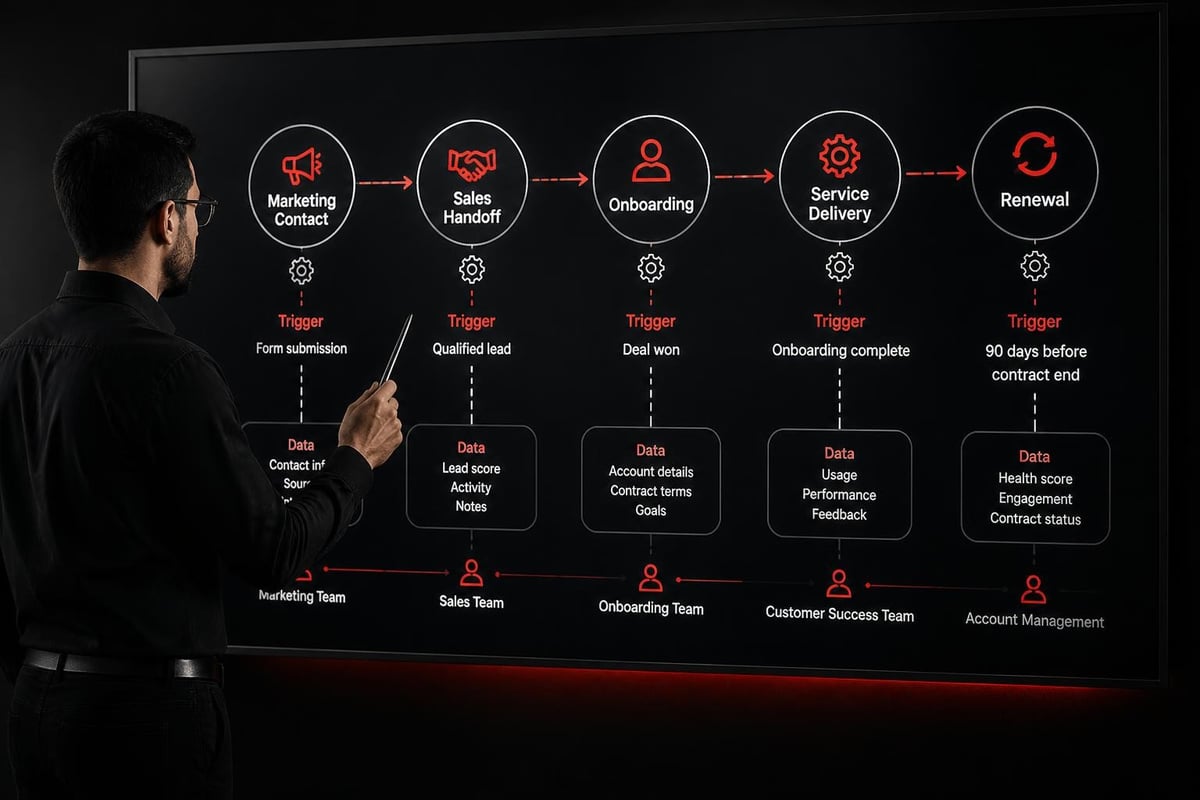
Technology enables connection, but process determines whether it actually works. The handover between marketing-generated interest and service delivery is where most revenue leaks occur. Prospects who expressed clear interest disappear. Sales conversations happen without full context. Onboarding begins with incomplete information. Service delivery teams discover promises that can’t be fulfilled.
These failures aren’t individual mistakes. They’re process gaps that technology alone won’t fix. Connected marketing and services requires deliberately designed workflows that maintain information continuity and accountability across every transition point.
Critical Handover Points
- Marketing to sales: Which information must transfer, what constitutes a qualified opportunity, how quickly sales must respond
- Sales to onboarding: What gets documented about customer expectations, timeline, scope, and commercial terms
- Onboarding to delivery: How customer information, project requirements, and success criteria move into service systems
- Delivery to retention: When renewal conversations begin, who owns them, what triggers intervention for at-risk customers
- Service to marketing: How delivery experience, satisfaction data, and expansion opportunities flow back to acquisition strategy
Each handover needs defined triggers, required information, responsible parties, timeframes, and escalation paths. These aren’t bureaucratic procedures. They’re commercial safeguards that prevent expensive failures.
Research from Deloitte’s Global Marketing Trends shows that organizations focusing on customer experience and organizational integration significantly outperform those maintaining traditional functional boundaries. The advantage comes from process discipline, not aspirational culture statements.
Automation That Supports Humans, Not Replaces Them
Marketing automation and AI workflows promise efficiency. Often they deliver rigid processes that frustrate customers and team members while optimising for metrics nobody actually cares about. Connected marketing and services uses automation strategically: handling repetitive tasks reliably while keeping humans involved where judgement, relationship, and context matter.
Automation should ensure no prospect falls through gaps, every customer receives timely communication, data moves between platforms consistently, and reporting happens continuously. It shouldn’t replace sales conversations, override service judgement, or send template responses to complex situations.
High-value automation in marketing and services:
- Lead capture and initial qualification scoring
- CRM data sync between marketing, sales, and service platforms
- Scheduled follow-up reminders based on customer lifecycle stage
- Onboarding task creation and progress tracking
- Renewal notification workflows triggered by contract dates
- At-risk customer identification based on usage or engagement decline
- Reporting dashboards that update automatically from connected systems
The distinction matters. Automating lead capture prevents prospects from being ignored. Automating sales conversations annoys people and damages conversion. Automating CRM updates eliminates duplicate entry errors. Automating renewal decisions removes the judgement that distinguishes profitable retention from expensive discounting.
Businesses examining where RPA and AI workflow automation creates genuine value versus unnecessary complexity should focus on repetitive processes with clear rules and measurable outcomes, not nuanced interactions where context drives decisions.
Common Integration Failures and How to Avoid Them
Most attempts to connect marketing and services fail not from wrong technology but wrong sequencing. Businesses buy sophisticated platforms before defining what integration should accomplish, implement features they don’t need while ignoring critical gaps, and declare victory based on deployment rather than measurable outcomes.
Why Integration Projects Fail
| Failure Pattern | What Happens | How to Avoid It |
|---|---|---|
| Technology first | Platforms purchased before understanding current state and requirements | Start with audit and process design, select tools that fit documented needs |
| Feature creep | Implementing every available integration instead of focusing on commercial priorities | Define success metrics before design, deploy minimum viable integration first |
| Insufficient data quality | Automated sync spreads existing errors faster across more systems | Fix data quality issues before automation, implement validation rules |
| No process change | Teams work around new systems to maintain familiar workflows | Redesign processes alongside technology, provide training on new workflows |
| Lack of ownership | Integration becomes IT project without marketing and service leadership | Assign executive sponsor, require business function participation |
Success requires treating integration as organizational change, not software implementation. The platforms are easy. Changing how teams work, what they measure, and how they’re rewarded is hard. Skipping the hard part produces expensive systems that get worked around.
Insights from Forrester’s analysis of CRM marketing services emphasize that technology enables modern marketing and services integration, but business process and data discipline determine whether implementations deliver value or create new problems.
Getting Started: Practical First Steps
Connected marketing and services doesn’t require replacing everything simultaneously. It starts with understanding current state, identifying the highest-value connections, and implementing changes that produce measurable commercial improvement before expanding scope.
Initial implementation sequence:
- Audit existing platforms and data flow: Document which systems hold customer information, how it moves between them, where quality degrades, and what commercial questions can’t be answered accurately
- Map the complete customer journey: Identify every touchpoint from first marketing contact through service delivery and renewal, noting where handovers occur and information gets lost
- Quantify current failure costs: Calculate revenue lost to poor handovers, duplicate effort from disconnected systems, and decisions made with incomplete data
- Prioritise integration points by commercial impact: Focus first on connections that prevent revenue loss or enable better capital allocation, not convenient technical projects
- Implement minimum viable integration: Connect critical platforms with essential data flow, validate it works reliably, then expand
- Redesign measurement around customer economics: Replace activity dashboards with metrics that track acquisition cost, conversion through the complete journey, and customer lifetime value
- Create feedback loops between service and marketing: Ensure delivery experience, satisfaction data, and retention patterns inform acquisition strategy continuously
This sequence produces visible commercial results quickly while building foundation for broader integration. The alternative is multi-year transformation programmes that consume budget without demonstrating value.
For established businesses with complex existing systems, understanding how marketing and growth strategies connect to operational delivery determines whether integration efforts support commercial objectives or just create sophisticated complexity.
The Strategic Advantage of Integration
Businesses that connect marketing and services properly gain competitive advantage that compounds over time. They acquire customers more efficiently because marketing optimises for profitable retention, not just lead volume. They deliver service more effectively because teams have complete customer context. They retain customers longer because delivery experience feeds back to improve acquisition targeting.
More importantly, they can answer questions competitors can’t: Which marketing channels generate customers that stay? What’s the true acquisition cost including sales and onboarding expense? Which customer segments are profitable to serve? Where should capital be allocated for maximum return?
This advantage isn’t temporary. Once established, connected systems create data assets and process discipline that become harder to replicate than any individual campaign or service offering. The businesses still running disconnected marketing and services operations in 2026 aren’t competing on equal terms. They’re trying to make strategic decisions with partial information while opponents see the complete commercial picture.
The path forward isn’t mysterious. It requires honest assessment of current state, commitment to process change alongside technology implementation, and patience to build foundation before adding sophistication. None of that is difficult. It’s just rare enough to create sustainable competitive separation.
Connected marketing and services transforms customer acquisition, delivery, and retention from separate activities into one measurable system where each function improves the others. The businesses that make this transition move faster, waste less, and understand their customer economics better than competitors still operating in silos. If your marketing and services functions work as disconnected departments with separate data, processes, and measurement, touchpoint.systems can audit your current state, design integration that supports commercial objectives, and build connected systems that replace expensive fragmentation with measurable growth.